
Mortgages
Complete guide to mortgages in Spain (2026): how they work and how to choose
Everything about mortgages in Spain: what they are, types (fixed, variable, mixed), costs, how much you can borrow and how to choose the best option in 2026.
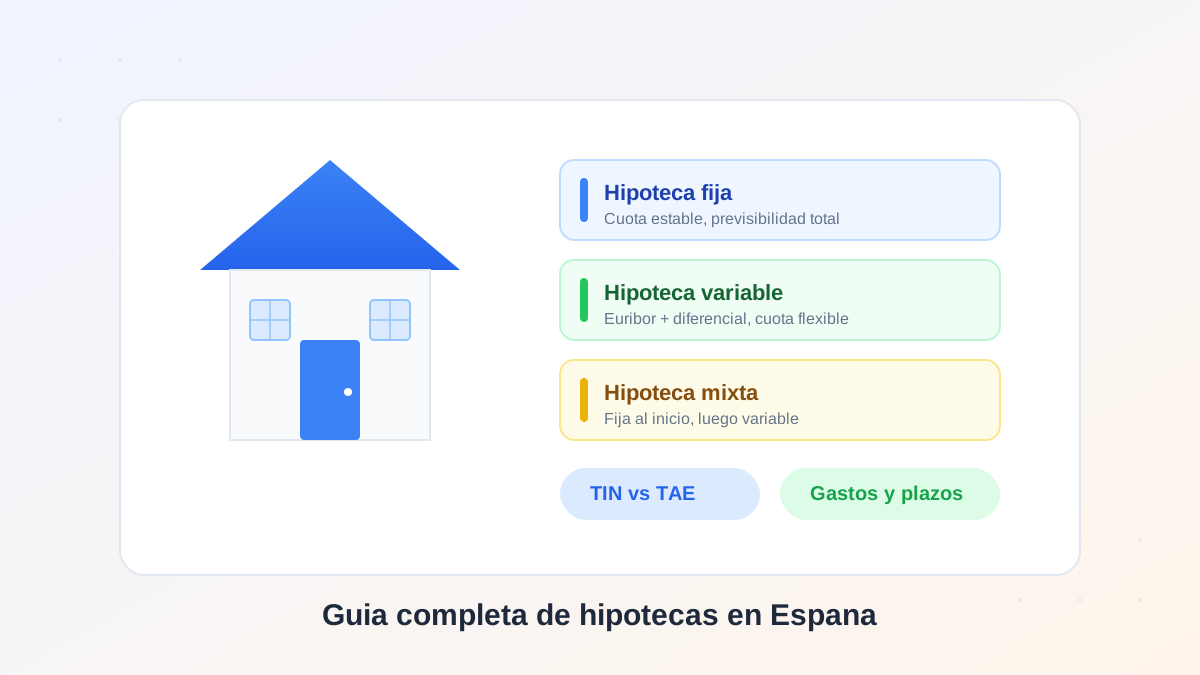
Buying a home is the most important financial decision for most families in Spain. And for nearly all of them, that purchase involves taking out a mortgage.
The problem is that many people sign without fully understanding what they are committing to, what options they have or how much it will really cost them. This guide explains how mortgages work in Spain, what types exist, what costs they involve and how to choose the option that best fits your situation.
What is a mortgage and how does it work
A mortgage is a loan granted by a bank to buy a property. In return, the bank holds the property as collateral: if you stop making payments, it can foreclose and take ownership of the property.
The basic mechanism is straightforward:
- You borrow a principal amount. For example, €180,000.
- You agree on an interest rate. It can be fixed, variable or mixed.
- You repay the loan in monthly instalments over an agreed term (typically between 15 and 30 years).
- Each instalment has two components: one that repays principal (reduces the debt) and one that covers interest.
At the beginning of the mortgage, most of your instalment goes towards interest. Over time, the proportion reverses and you repay more and more principal. This mechanism is known as amortización francesa (French amortisation system), and it is used by virtually all mortgages in Spain.
Key takeaway: the monthly instalment is not the only thing you pay the bank. You also need to factor in insurance, taxes and associated costs. The real cost of a mortgage is always higher than the instalment alone.
Types of mortgage
There are three main types of mortgage in Spain. The difference between them lies in how the interest you pay is calculated.
Fixed-rate mortgage
The interest rate is locked in at signing and does not change for the entire life of the loan. If you sign at 2.80%, you will pay that 2.80% from the first month to the last. This means a constant instalment and total predictability: you know exactly how much you pay every month for the whole mortgage. In exchange, the initial rate is usually somewhat higher than that of a variable-rate mortgage at the time of signing.
This is currently the most common option in Spain. According to INE data, fixed-rate mortgages have represented the majority of new originations since 2022.
Variable-rate mortgage
The interest rate is reviewed periodically (every 6 or 12 months) based on a reference index, usually the Euríbor. Your rate will be Euríbor plus a fixed spread agreed with the bank. For example, if you sign at Euríbor + 0.80% and the Euríbor is at 2.50%, your rate is 3.30%. If the Euríbor drops to 2.00%, you pay 2.80%; if it rises to 3.00%, you pay 3.80%.
The advantage is the potential for savings when rates fall. The downside is uncertainty: your instalment can go up or down at each review and you do not know what you will be paying in 5 or 10 years.
Mixed-rate mortgage
This combines an initial fixed-rate period (usually between 3 and 10 years) with a subsequent variable-rate period. It offers stability at the start — when you tend to have less financial headroom — and flexibility later, if you are confident that rates will hold steady or fall. It may suit you if you are looking for something in between security and potential savings.
If you want to dive deeper into which type suits your profile, see Fixed or variable mortgage in 2026: which suits you best.
What to consider before taking out a mortgage
Before signing, there are three fundamental variables you need to understand and compare across offers.
Interest: TIN vs TAE
These are two ways of expressing the cost of a mortgage, and they do not mean the same thing.
- TIN (Tipo de Interés Nominal / Nominal Interest Rate): the percentage the bank charges you in pure interest, excluding fees and additional costs.
- TAE (Tasa Anual Equivalente / Annual Equivalent Rate): includes the TIN plus fees, tied products (insurance, credit cards) and other costs the bank requires in order to offer you those conditions.
| Concept | TIN | TAE |
|---|---|---|
| Pure interest | Yes | Yes |
| Fees | No | Yes |
| Tied products | No | Yes |
| Useful for comparing | Not entirely | Yes |
Rule of thumb: always compare by TAE, not TIN. Two mortgages with the same TIN can have very different total costs if one requires more tied products than the other.
Term
The typical mortgage term in Spain ranges from 15 to 30 years, with a legal maximum of 40 years (although few banks offer more than 30).
The term determines a key trade-off:
- Longer term → lower monthly instalment, but you pay more interest overall.
- Shorter term → higher instalment, but lower total cost.
Approximate example on a principal of €180,000 at a 3.00% fixed rate:
| Term | Approx. monthly instalment | Approx. total interest |
|---|---|---|
| 20 years | ~€999 | ~€59,700 |
| 25 years | ~€854 | ~€76,100 |
| 30 years | ~€759 | ~€93,200 |
The difference between 20 and 30 years can exceed €30,000 in interest. That is why it is worth choosing the shortest term that allows you to maintain a comfortable instalment — not the maximum instalment you could bear.
Savings required
Banks in Spain typically finance up to 80% of the appraised value or the purchase price (whichever is lower). This means you need to contribute at least the remaining 20% as a down payment.
But the down payment is not the only expense. On top of that, you must add the purchase taxes and costs, which represent an additional 10% to 15% of the property price.
If you are under 35 and the main barrier is the initial deposit, also review the guide to young home buyer aid in Spain in 2026, which explains ICO guarantees, limits and typical requirements.
In total, to buy a home you need to have saved approximately 30–35% of its value:
| Concept | Approx. percentage |
|---|---|
| Down payment (the part the bank does not finance) | 20% |
| Taxes (ITP or IVA + AJD) | 6–10% |
| Notary, land registry, agency | 1–2% |
| Appraisal | ~0.1–0.2% |
| Estimated total | ~30–35% |
For a property worth €250,000, you need between €75,000 and €87,500 saved before buying.
Key takeaway: some banks finance more than 80% for certain profiles (civil servants, high salaries, properties from their own portfolio), but these are exceptions. The prudent approach is to plan based on 80%.
How much can you borrow
Banks assess your borrowing capacity before granting a mortgage. The main criterion is the debt-to-income ratio: the percentage of your net monthly income that goes towards paying debts.
The standard benchmark used by lenders in Spain is that your mortgage instalment (plus other debts) should not exceed 30–35% of your net income.
Practical example:
| Net monthly income | Max. instalment (at 35%) | Approx. principal over 25 years at 3% |
|---|---|---|
| €2,000 | ~€700 | ~€148,000 |
| €2,500 | ~€875 | ~€185,000 |
| €3,000 | ~€1,050 | ~€222,000 |
| €4,000 | ~€1,400 | ~€296,000 |
These figures are indicative. The actual amount a bank will grant depends on additional factors: job stability, type of contract, seniority, other loans, age, risk profile and each institution's commercial policy.
Important: just because a bank is willing to lend you a certain amount does not mean you should borrow the full sum. Your comfortable instalment may well be lower than the maximum instalment you could obtain.
Mortgage costs in Spain
Costs fall into two categories: those paid when buying the property and those arising from the mortgage itself.
Purchase costs
- ITP (property transfer tax): paid on second-hand properties. Ranges between 4% and 10% depending on the Comunidad Autónoma (autonomous community).
- IVA (VAT) + AJD (stamp duty): paid on new-build properties. IVA of 10% (4% for subsidised housing) plus the AJD on the purchase deed.
- Notary and land registry for the purchase deed: borne by the buyer.
Mortgage costs
Since Law 5/2019 regulating real estate credit contracts, most mortgage formalisation costs are borne by the bank:
- Mortgage notary fees: paid by the bank.
- Mortgage land registry fees: paid by the bank.
- Agency fees: paid by the bank.
- AJD on the mortgage: paid by the bank.
- Appraisal: paid by the borrower (typically between €250 and €500).
- Arrangement fee: some banks charge one, others do not. Compare.
Recurring costs
- Home insurance: mandatory when you have a mortgage (covers damage to the property).
- Life insurance: not legally required, but many banks demand it in order to offer a discounted interest rate.
- Tied products: direct debit of salary, credit card, pension plan… each tie-in has a cost you should evaluate.
Which type of mortgage suits you?
There is no one-size-fits-all answer. It depends on your financial profile, your risk tolerance and your expectations about interest rates.
A practical way to decide:
| Profile | Recommended type | Why |
|---|---|---|
| You want to know exactly what you pay every month | Fixed | You eliminate uncertainty. Stable instalment even if rates rise |
| You believe rates will fall or you accept some risk | Variable | You may pay less if the Euríbor drops. But you take on the opposite risk |
| You want stability at first and flexibility later | Mixed | Combines initial security with potential medium-term savings |
| Your income is tight and you cannot absorb increases | Fixed | A Euríbor rise could jeopardise your budget |
| You plan to make early repayments within a few years | Variable | If you will shorten the term significantly, rate variability affects you less |
Whatever you choose, the important thing is that the decision is based on numbers and scenarios, not on predictions or sales pressure.
For a more detailed analysis, see Fixed or variable mortgage in 2026: which suits you best.
How to calculate your mortgage
Before talking to any bank, it is worth running your own numbers. The goal is not to calculate the instalment to the last cent, but to have a clear idea of what you can afford and what you cannot.
To calculate a mortgage you need three pieces of data: the principal you are going to borrow, the annual interest rate (fixed, or an estimate if variable) and the repayment term in years. With these values you can estimate the monthly instalment, the total interest and the overall cost of the operation.
Our mortgage calculator lets you enter these figures along with the property price and down payment, and instantly see the instalment, cost breakdown and the evolution of interest versus principal over the entire life of the loan.
It is advisable to simulate at least three scenarios: one with the conditions the bank is offering you (base scenario), another with somewhat lower rates (favourable scenario) and a third with higher rates (stress scenario), to check that you can keep paying without being stretched too thin. If the stress scenario breaks your budget, the deal is too tight.
Frequently asked questions about mortgages
How much money do I need to buy a house?
You need to have saved approximately 30–35% of the property price. This includes the down payment (20% that the bank does not finance) plus purchase taxes and costs (10–15%). For a property worth €200,000, you need between €60,000 and €70,000.
What is the Euríbor and why does it matter?
The Euríbor (Euro Interbank Offered Rate) is the interest rate at which European banks lend money to each other. It is used as the benchmark for calculating interest on variable-rate mortgages in Spain. If the Euríbor goes up, your instalment goes up. If it goes down, your instalment goes down. It is reviewed every 6 or 12 months as specified in your contract.
For the latest practical context, see Euribor in May 2026 and how the latest published figure may affect variable mortgages.
Is it better to reduce the term or the instalment?
It depends on your situation. Reducing the term usually saves more interest overall. Reducing the instalment gives you more monthly breathing room. If your budget is comfortable, go for the term. If you need monthly relief, go for the instalment. In either case, do not make early repayments if it would leave you without an emergency fund. More detail in Early mortgage repayment: when it makes sense and how to calculate it.
Can I change my mortgage after signing?
Yes, there are two main routes:
- Novación (renegotiation with your bank): you negotiate new conditions with your current bank.
- Subrogación (transferring the mortgage to another bank): you transfer the mortgage to another bank that offers better conditions.
Both options have associated costs that you should compare against the savings you would achieve. Law 5/2019 made these processes cheaper than under previous regulations.
Can I get a mortgage if I am self-employed?
Yes, although lenders usually request more documentation: IRPF (personal income tax) returns for recent years, proof of income, status of your business activity, etc. They may also require a higher down payment percentage or apply somewhat stricter conditions.
Are mortgage costs paid by the bank or the buyer?
Since 2019, the mortgage formalisation costs (notary, land registry, agency and AJD) are paid by the bank. The buyer pays the appraisal and the purchase costs (taxes, notary and land registry for the purchase deed).
Next steps
If you want to run specific numbers with your own data, use the mortgage calculator to calculate the instalment, the interest and see a visual cost breakdown.
If you have the basics clear and want to decide between fixed, variable or mixed, see Fixed or variable mortgage in 2026: which suits you best.
If you already have a mortgage and want to know whether it makes sense to repay early, see Early mortgage repayment: when it makes sense and how to calculate it.
To plan your savings before buying, start with the Personal Savings Guide for Spain.
Sobre el contenido de esta guía
Este artículo ha sido escrito por Cristian Moreno para Finanzas Fáciles. Analizamos datos de organismos oficiales como el Banco de España y el INE.
Las guías se revisan periódicamente para reflejar cambios económicos y financieros en España. Este contenido es informativo y educativo. No constituye asesoramiento financiero, fiscal ni legal personalizado.