
Mortgages
What is Euribor and why does it go up or down
A simple explanation of what Euribor is, how it relates to ECB rates, and how it affects variable-rate mortgages in Spain.
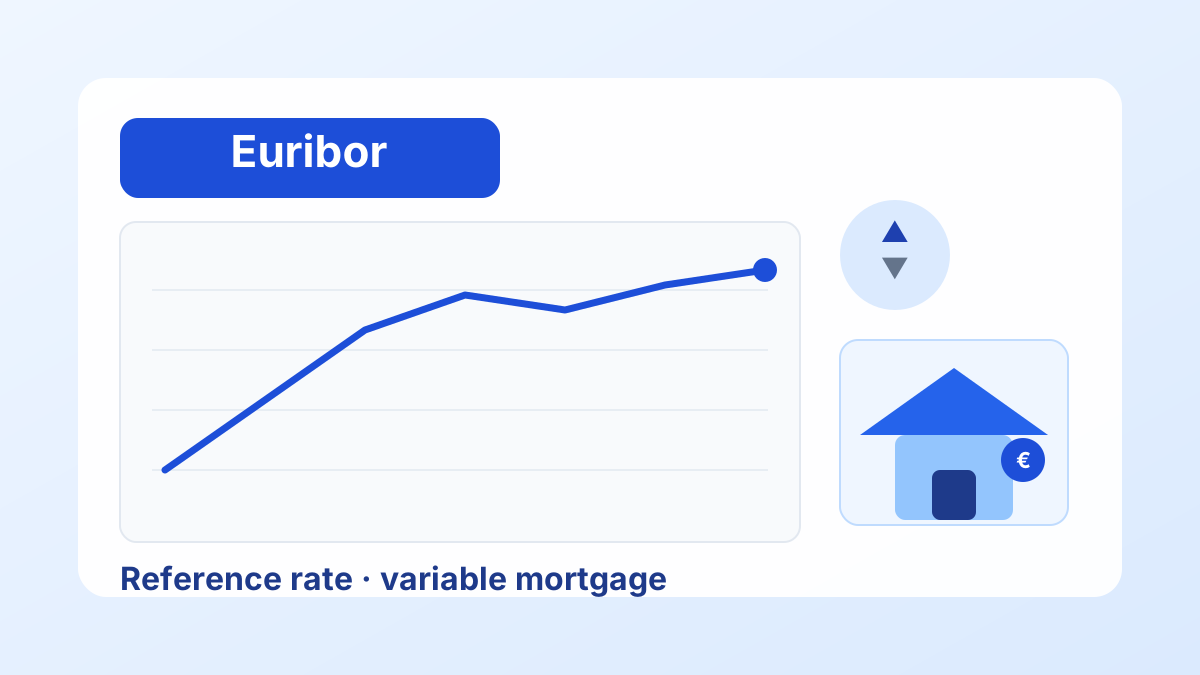
If you have a variable-rate mortgage in Spain or are thinking about getting one, you have probably heard about Euribor many times without being entirely sure what it means. You also see it rise and fall whenever the European Central Bank announces an interest rate decision. Euribor is the main reference index for variable mortgages in Spain, and understanding how it works and why it moves can help you make better financial decisions.
This article explains it in plain terms, without complicated formulas. For a broader look at how mortgages work in Spain, see the mortgages pillar, the complete mortgage guide for Spain, or the comparison between fixed and variable mortgages in the guide.
What is Euribor in simple terms?
Euribor (Euro Interbank Offered Rate) is the interest rate at which major eurozone banks lend money to each other in the interbank market. In other words, it is the price at which banks finance themselves from one another in the short and medium term.
The most common version is 12-month Euribor, which is the one most widely used as a reference rate for calculating variable mortgage payments in Spain. There are versions for different time horizons (one week, one month, three months, six months), but the 12-month version has the most day-to-day impact on household mortgages.
Euribor is not set directly by any single bank or government. It is calculated daily from data reported by the main European banks on the conditions at which they are lending to each other at that moment. The result is an index that reflects the state of the money market in the eurozone.
What is Euribor used for in a variable mortgage?
When you take out a variable-rate mortgage, the interest rate you pay is not fixed for the life of the loan. Instead, it is updated periodically — typically every 6 or 12 months — based on Euribor plus a spread that the bank sets when you sign the contract.
The basic formula is:
Your mortgage interest rate = Euribor + bank spread
For example, if 12-month Euribor is at 2.5% and your mortgage has a spread of 0.8%, the interest rate applied at your next review would be 3.3%. If Euribor rises to 3.0%, your rate goes to 3.8%. If it falls to 2.0%, your rate drops to 2.8%.
That is what causes a variable mortgage payment to change over time: Euribor moves, and the bank applies the new rate at each periodic review. You can model different scenarios with the mortgage calculator.
Euribor vs mortgage interest rate: what is the difference?
This is a common source of confusion. Euribor and your mortgage interest rate are not the same thing, even though they are related.
Euribor is the market reference index. It is public, it changes every day, and no individual bank controls it. Your mortgage interest rate is the result of adding that index to the spread you agreed with your bank when taking out the loan. The spread is fixed for the life of the loan (unless you agreed otherwise), while Euribor changes continuously.
In short: Euribor is the "cost of money" in the market. The spread is the bank's margin. Your payment depends on both combined.
How does Euribor relate to the ECB and interest rates?
The ECB (European Central Bank) does not set Euribor directly, but it has a very strong influence on it. The ECB sets the official interest rates for the eurozone, which is the rate at which it lends money to commercial banks. When the ECB raises official rates, borrowing in the interbank market becomes more expensive, and that feeds through to Euribor, which usually rises as well. When the ECB cuts rates, the effect is the opposite.
This is not a perfect one-to-one relationship, but the correlation is very high. That is why every time the ECB announces an interest rate decision, media coverage immediately discusses the potential impact on Euribor and variable-rate mortgages.
Other factors also matter: market expectations about future ECB decisions, inflation, eurozone economic growth, and the general state of the financial system. Euribor reflects how banks see the cost of money in the short and medium term, and that perception depends not only on today's official rate but also on what markets expect to happen next.
Why does Euribor go up or down?
Euribor rises when:
- The ECB raises official interest rates to control inflation or for other monetary policy reasons.
- Markets anticipate that the ECB will raise rates in the near future.
- Inflation in the eurozone is high and persistent, putting pressure on the ECB to act.
- The financial system shows stress and banks demand higher rates to lend to each other.
Euribor falls when:
- The ECB cuts official rates to stimulate credit and economic growth.
- Markets expect rate cuts in the near future.
- Inflation moderates and the central bank has room to ease monetary policy.
- Interbank market conditions improve and banks lend to each other at lower risk premiums.
An important point: Euribor can move before the ECB acts formally, because markets anticipate what they believe will happen. That is why you sometimes see Euribor start to fall weeks before the ECB officially announces a rate cut.
How does Euribor affect your variable mortgage payment?
The impact of Euribor on your monthly payment depends on three factors: your remaining principal, the term left on your loan, and the spread you agreed with the bank.
When your review date arrives, the bank calculates the new interest rate using the Euribor from the previous month (or two months earlier, depending on your contract). That new rate is applied to your remaining principal to recalculate your payment for the next period.
If Euribor has risen since the last review, your payment goes up. If it has fallen, your payment goes down. The change can be modest or significant depending on the loan amount and remaining term. A one-percentage-point rise in Euribor on a €150,000 mortgage with 25 years remaining can mean roughly €60–80 more per month, though the exact figure varies.
For the latest published Euribor figure and what it means for your next review, see the article on Euribor in May 2026 and its impact on variable mortgages.
Does Euribor also affect savings?
Indirectly, yes. When Euribor is high, banks tend to offer better conditions on deposits and savings accounts, because the cost of money in the market is also higher. When Euribor falls, returns on savings products tend to fall too.
This mechanism is not perfectly symmetric: banks usually pass on rises faster than cuts when it comes to deposit products. But in general terms, the rate environment reflected by Euribor affects both the cost of credit and the return on savings.
Frequently asked questions
Is Euribor the same as my mortgage interest rate?
No. Euribor is the reference index from the interbank market. Your variable mortgage interest rate is the result of adding Euribor to the spread you agreed with the bank when you took out the loan.
Who decides Euribor?
Nobody sets it directly. It is calculated daily from data reported by the main eurozone banks on their interbank lending conditions. The ECB influences it through its interest rate policy, but does not fix it.
Why does Euribor change?
Mainly because the interest rate environment in the eurozone changes, which in turn depends on ECB monetary policy, inflation, market expectations, and financial system conditions.
How does it affect my monthly payment?
At each periodic review of your variable mortgage (every 6 or 12 months), the bank recalculates your payment using the current Euribor plus your spread. If Euribor has risen, the payment goes up. If it has fallen, the payment goes down.
Can Euribor fall even when ECB rates are still high?
Yes, to some extent. Euribor also reflects market expectations about future rate cuts. If investors expect the ECB to cut rates soon, Euribor can anticipate that move before it formally happens.
Does Euribor affect savings too?
Indirectly yes. A high Euribor environment usually comes with better conditions on deposits and savings accounts. When Euribor falls, savings returns tend to shrink as well.
Conclusion
Euribor is the key reference index for variable-rate mortgages in Spain. It rises when the eurozone interest rate environment tightens and falls when monetary policy eases. Its relationship with the ECB is very close, though not mechanical. If you have a variable mortgage, understanding how this index works helps you anticipate how your payment may change at the next review and weigh your options more clearly before making decisions about your loan.
Sobre el contenido de esta guía
Este artículo ha sido escrito por Cristian Moreno para Finanzas Fáciles. Analizamos datos de organismos oficiales como el Banco de España y el INE.
Las guías se revisan periódicamente para reflejar cambios económicos y financieros en España. Este contenido es informativo y educativo. No constituye asesoramiento financiero, fiscal ni legal personalizado.