
Savings
Emergency fund in Spain: how much money to keep and where to hold it
Learn how to calculate an emergency fund in Spain based on your expenses, income stability, and risk profile, and where to keep it safely.
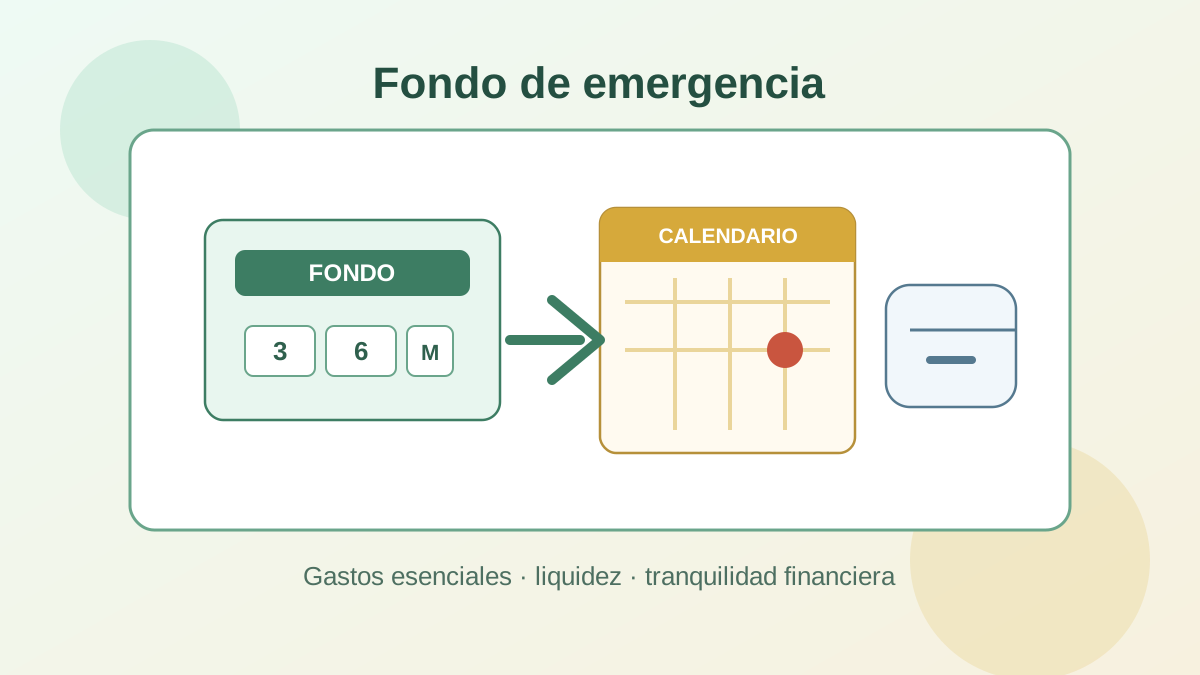
An emergency fund in Spain is money you keep aside so that unexpected events do not force you into expensive debt, selling investments at the wrong time, or disrupting your entire budget. It is not holiday savings, a house deposit, or money you plan to invest: it is your financial safety cushion.
In Spain, where housing, utilities, and family costs can take up a large share of monthly income, keeping this money separate matters. A car repair, home issue, income gap, or job transition should not automatically push you towards credit card debt or a personal loan.
This guide explains how much to keep, how to calculate it using your own expenses, and where to hold it. For the broader content hub, start with the savings pillar.
What an emergency fund is
An emergency fund is a liquid reserve for important, unexpected, and necessary expenses. The key word is "necessary": it is not for impulse purchases or investment opportunities, but for stability.
Reasonable uses include:
- Urgent car repairs if you need the car for work.
- Replacing an essential appliance.
- Unexpected medical or family expenses.
- Covering a temporary income gap.
- Insurance excesses, forced moves, or essential home repairs.
It should not be used for sales, holidays, a phone upgrade, or investing because "markets are down". Those goals deserve separate savings pots. Clear separation prevents the fund from being drained by decisions that were not real emergencies.
How much money should you keep?
The most useful benchmark is not a fixed euro amount, but months of essential expenses. Two people with EUR 10,000 saved may be in very different positions if one spends EUR 900 per month and the other spends EUR 2,400.
As a starting point:
- Stable salary, few dependants: 3 to 4 months of essential expenses.
- Variable income, self-employment, or unstable sector: 6 months or more.
- Children, high mortgage or rent, or one household income: 6 to 9 months.
- Expensive debt outstanding: build a mini fund first, then repay aggressively, then complete the fund.
You do not need to reach the final target at once. Trying to build a large cushion too quickly can be discouraging. Working in stages is usually more sustainable.
How to calculate it step by step
Start with your real monthly essential expenses, not an idealised version of your budget. Review the last 3 months of transactions and separate what is necessary:
- Housing: rent or mortgage, community fees, and mandatory insurance.
- Utilities: electricity, gas, water, internet, and basic phone service.
- Food and household basics.
- Necessary transport.
- Health, insurance, and recurring medication.
- Minimum debt payments.
- Essential family costs.
Then multiply that figure by the number of months you want to cover.
Example: if your essential expenses are EUR 1,450 per month and you want a 4-month cushion, your target fund is EUR 5,800. If you are self-employed and prefer 6 months, the target rises to EUR 8,700.
If you still do not know how to classify expenses, start with the personal savings guide for Spain. Without a basic budget, an emergency fund is calculated blindly.
Build it in stages
A common mistake is thinking the fund only matters once it is complete. In reality, every stage lowers risk.
Stage 1: mini fund
The first target can be EUR 500 to EUR 1,000. It will not cover job loss, but it can stop a small repair from becoming credit card debt or an overdraft.
Stage 2: one month of essentials
At this point, you have room to absorb several smaller emergencies or a delayed payment. For many people, reaching one month already reduces financial anxiety.
Stage 3: complete fund
Once you have 3 to 6 months, or more if your situation requires it, you can balance other goals more calmly: investing, mortgage repayment, training, or saving for a home.
The personal savings guide for Spain can help you order those goals without mixing them.
Where to keep an emergency fund
The priority is liquidity and safety. Return matters, but it should not be the main criterion.
Reasonable options include:
- A remunerated account or savings account with no fees.
- A very short-term deposit if you can access the money without meaningful penalties.
- Part in a current account and part in a separate low-risk liquid product.
If you are choosing between the first two options, the guide to remunerated accounts versus time deposits in Spain explains which part of the cushion should stay fully accessible and which part can have a maturity date.
What to avoid:
- Stocks, equity funds, or cryptoassets.
- Products with long liquidity windows.
- Mixing it with your daily spending account if that makes it too easy to spend.
- Keeping it in an account with high fees.
A practical structure is to keep an immediate layer, such as 1 month of expenses, in a very accessible account and the rest in a separate account. That way it is not so close that you spend it casually, but it is still available when it truly matters.
Emergency fund before investing
Investing without a safety cushion can be expensive. If markets fall and you need cash at the same time, you may have to sell at a loss. The emergency fund prevents your investments from becoming the pot you use for every problem.
A prudent sequence is often:
- Mini fund.
- Budget control and expensive debt repayment.
- Functional fund of 1 to 3 months.
- Gradual investing if your time horizon is long.
- Full fund based on your personal risk.
If you are new to investing, read how to invest in Spain first. Investing makes more sense when it does not rely on money you may need soon.
When to use it and how to rebuild it
Before touching the fund, ask three questions:
- Is it necessary?
- Is it urgent?
- Was it not already planned in another savings pot?
If the answer is yes, use it without guilt: that is what it is for. The important part is rebuilding it afterwards. For a few weeks or months, you can pause secondary goals and redirect monthly savings back to the fund until it returns to target.
You should also review it once a year or whenever your life changes: moving home, having children, taking on a new mortgage, changing jobs, becoming self-employed, or seeing fixed costs rise. A fund that was enough two years ago may be too small today.
Common mistakes
The first mistake is calculating the fund based on income rather than expenses. Earning EUR 2,500 does not automatically mean you need EUR 15,000 in cash; it depends on how much you need to live if things get difficult.
The second is chasing too much return. If a product offers a slightly higher yield but adds lock-up periods, volatility, or risk of loss, it may no longer fit the fund's purpose.
The third is not separating goals. If the same money is meant for emergencies, holidays, a house deposit, and investing, in practice it is not properly assigned to anything.
Conclusion
An emergency fund will not make you rich, but it gives you room to breathe. That room helps you avoid expensive decisions: borrowing in a hurry, selling investments at the wrong time, or treating every unexpected event as a crisis.
Start with a mini fund, calculate your essential expenses, and build the cushion in stages. Once it is in place, your budget becomes more resilient and your financial decisions become less reactive.
This article is educational and informational only. It is not personalised financial advice.
Sobre el contenido de esta guía
Este artículo ha sido escrito por Cristian Moreno para Finanzas Fáciles. Analizamos datos de organismos oficiales como el Banco de España y el INE.
Las guías se revisan periódicamente para reflejar cambios económicos y financieros en España. Este contenido es informativo y educativo. No constituye asesoramiento financiero, fiscal ni legal personalizado.