
Savings
Remunerated account or time deposit in Spain: where to keep your savings
Compare remunerated accounts and time deposits in Spain: liquidity, returns, penalties, deposit protection and how to choose based on your savings goal.
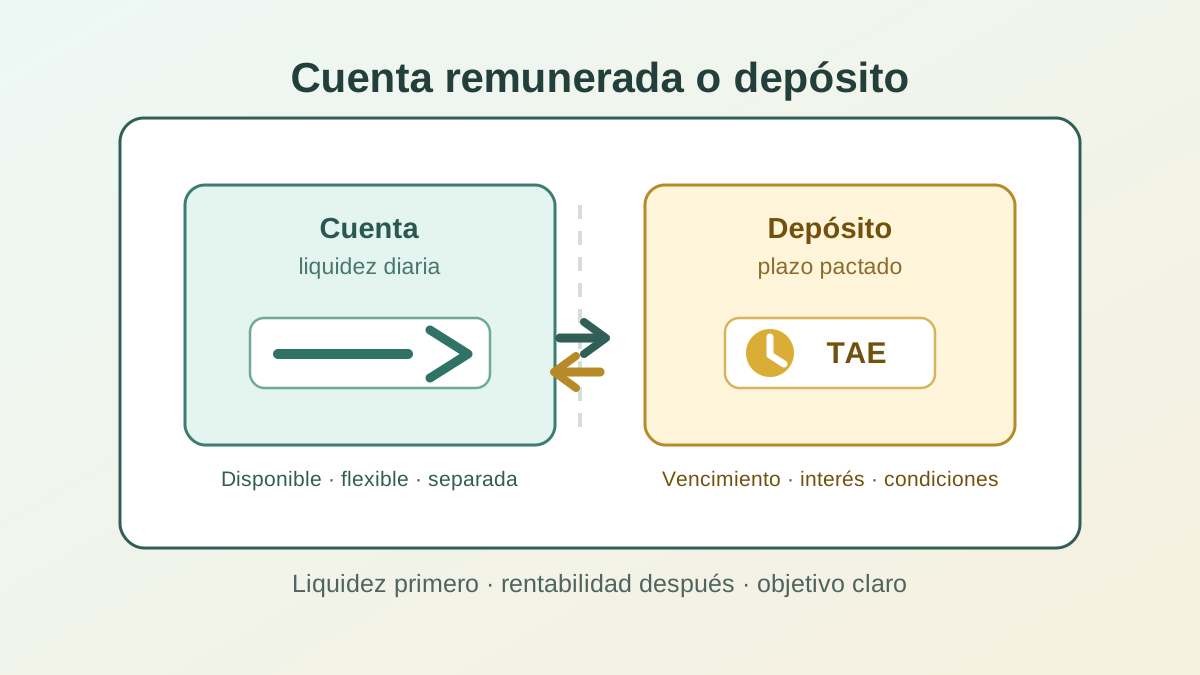
Remunerated account or time deposit in Spain: where to keep your savings
Choosing between a remunerated account or a time deposit in Spain is not just about chasing the highest advertised rate. It is really about matching each part of your savings with the right level of liquidity. Money for emergencies should not be treated the same way as money you know you will not need for the next six or twelve months.
Both products can help you avoid leaving cash idle in a non-interest current account. The difference is that one prioritises access and flexibility, while the other usually asks you to commit the money for a defined period.
This guide compares remunerated accounts, savings accounts and time deposits from a practical Spain-focused perspective. If you are still building your base, start with the savings pillar and the personal savings guide for Spain.
What a remunerated account is
A remunerated account is a bank account that pays interest on the balance you keep in it. Depending on the bank, it may work like a current account, a savings account or a separate account for specific goals.
Its main advantage is liquidity. Demand accounts allow customers to withdraw their money when they ask for it, without a maturity penalty. That makes a remunerated account useful for money you want to keep close: an emergency fund, short-term goals or cash that has not yet been assigned to a longer-term purpose.
The weak point is the fine print. Some accounts advertise an attractive rate only up to a certain balance, for a promotional period, or if you meet requirements such as salary direct debit, bills or card usage. Others charge fees if you stop meeting conditions. So the headline percentage is only the starting point.
What a time deposit is
A time deposit is a banking product where you place money with a bank for a fixed period and, at maturity, receive the principal plus the interest agreed in the contract. The basic trade-off is simple: you accept less access for a period in exchange for a more predictable return.
The important difference from a remunerated account is the time commitment. Banco de España explains that time deposits have a maturity date. If the contract allows early cancellation, there may be a penalty or fee, and those conditions must be included in the contract.
That makes a time deposit more suitable for money you do not need immediately. For example: part of your savings for a goal in 9 months, a reserve above your emergency fund, or cash you do not want to invest because the horizon is too short.
Key differences between account and deposit
The decision becomes clearer when you compare four variables: liquidity, return, conditions and time horizon.
| Criterion | Remunerated account | Time deposit |
|---|---|---|
| Liquidity | High: money is usually available | Low or medium: depends on maturity and early cancellation rules |
| Return | Variable and subject to changes | Agreed for a specific term |
| Typical use | Emergency fund, near-term goals, temporary cash | Savings you do not need for several months |
| Main risk | Fees, limits, changing rates | Penalties, rollover, lack of liquidity |
A remunerated account gives flexibility. A time deposit gives structure. If you do not know when you will need the money, flexibility matters more. If you know you will not touch it for a defined period, the deposit structure can help you earn interest and avoid spending it early.
When to choose a remunerated account
A remunerated account is usually better when the priority is access. The clearest example is the emergency fund in Spain: you need it protected, separate from daily spending and available when something serious happens.
It can also work for short-term goals. If you expect to pay annual insurance, a move, a known repair or a trip within a few months, locking the money in a deposit can be inconvenient. A remunerated account lets you separate the goal while keeping room to move.
Prioritise a remunerated account if:
- You may need the money at any time.
- You are still building your emergency cushion.
- You want to automate monthly savings without contracting a new product each time.
- The rate is reasonable without conditions that make the account awkward.
- Simplicity matters more than squeezing out a slightly higher return.
The downside is that conditions can change. A bank may pay a strong promotional rate for a few months and reduce it later. Check the duration, maximum remunerated balance, fees and requirements before moving money.
When to choose a time deposit
A time deposit fits better when you know a portion of your savings should not be touched for a specific period. It is not a place for all your liquid money; it is a tool for the layer that can be organised by maturity dates.
Example: you have EUR 12,000 in emergency savings. You decide to keep EUR 4,000 in an immediately accessible account and place EUR 8,000 in short deposits, provided you accept that this second layer is less accessible. Another case: you need EUR 6,000 for a goal in one year and want to keep it away from daily spending.
Prioritise a time deposit if:
- The money has a clear horizon of several months.
- You already have enough immediate liquidity.
- The AER compensates you compared with a similar remunerated account.
- You understand what happens if you cancel before maturity.
- There is no automatic rollover that could lock the money again unexpectedly.
The mistake would be using a deposit for money you might need tomorrow. Even if early cancellation is possible, relying on it adds friction to what should be a simple safety decision.
Best remunerated accounts in June 2026: examples to compare
Offers change quickly, so this list should be read as a market snapshot as of 4 June 2026, not as personalised advice. Before opening an account, confirm the bank's current terms, AER, balance limits and access conditions.
Some remunerated accounts that stand out in Spain in June 2026 are:
| Account | Advertised return | What to check |
|---|---|---|
| Trade Republic | 3.04% AER for new customers | Advertised with no cash balance limit, daily accrual and monthly payout. Cash is held with partner banks and covered by the applicable deposit guarantee scheme up to EUR 100,000 per customer and institution. |
| EBN Banco Cuenta Remunerada | 2.50% AER in the example published by the entity | No salary direct debit or mandatory linked products, but it is not an operating account: it does not allow direct debits, charges or cards. It is more useful as a separate savings account. |
| Openbank Cuenta Remunerada | 2.02% AER for one year | Aimed at new customers with promotional conditions, such as bringing Bizum and using the campaign code until 30/06/2026. Openbank is covered by Spain's deposit guarantee fund. |
Do not choose only by AER. A 3% account with conditions that do not fit your life may be worse than a simpler 2.5% account. For emergency money, access, tax handling and fees matter as much as the headline rate.
Best time deposits in June 2026: examples to compare
Deposits are useful for money with a date and margin. In June 2026 there are attractive offers, but many depend on being a new customer, bringing new money, accepting a specific term or losing interest if you cancel early.
Relevant examples include:
| Deposit | Advertised return | What to check |
|---|---|---|
| Banco BiG Gran Depósito 3 meses | 3.25% AER for 3 months | For new customers and money from other institutions. No partial additions or withdrawals; early cancellation means losing interest. Banco BiG is covered by Portugal's deposit guarantee fund. |
| Renault Bank Depósito Tú+ | 3.19% AER for 36 months | Long term: potentially interesting if you do not need liquidity, but it requires accepting three years of commitment. Conditions are advertised as valid until 17/06/2026. |
| Deutsche Bank Depósito Más DB | 2.25% AER for 12 months | Also offers 3- and 6-month terms with lower AER. Minimum investment from EUR 3,000 and coverage by Spain's deposit guarantee fund up to EUR 100,000 per depositor. |
A prudent way to use deposits is to stagger maturities: for example, keep one layer in a remunerated account and another in 3-, 6- or 12-month deposits. That way you avoid having all your savings locked until the same date.
What to check before opening one
Before moving money, compare the full conditions. The important question is not just how much the product pays, but how much it pays after limits, costs and restrictions.
Check especially:
- AER and real term. The AER helps compare offers, but you must know how long the rate lasts and which balance it applies to.
- Maximum remunerated balance. An account paying 3% up to EUR 5,000 is not the same as a deposit paying 3% on EUR 20,000.
- Fees. Maintenance fees, transfers, mandatory cards or linked-product requirements can reduce the real return.
- Early cancellation. For deposits, confirm whether it is allowed and what it costs.
- Automatic rollover. If it exists, note the maturity date so you can decide before the bank renews it.
- Entity and guarantee scheme. Confirm which deposit guarantee fund covers the product and the applicable limit.
If you are comparing because inflation worries you, connect this decision with the broader question of keeping too much idle cash. A bank account or deposit can reduce the loss of purchasing power, but it will not always beat inflation.
Deposit Guarantee Fund: what is covered
In Spain, the Deposit Guarantee Fund generally protects eligible cash deposits up to EUR 100,000 per holder and per institution. Covered deposits include account balances, savings deposits and fixed-term deposits, provided they fall within the applicable rules.
The phrase "per holder and per institution" matters. If you hold EUR 120,000 at one institution, you should not assume that the entire amount is covered in the same way. If you hold EUR 60,000 at one institution and EUR 60,000 at another, the coverage is assessed separately.
It is also important to distinguish bank deposits from investment products. An investment fund, ETF or share is not the same as a bank account or a time deposit. They may be regulated and held through a financial institution, but they do not follow the same deposit-guarantee logic.
Practical examples
Case 1: emergency fund under construction
If you are building your first EUR 3,000 or EUR 5,000 of emergency savings, a separate remunerated account is usually enough. The goal is liquidity, habit and clarity. Locking the money in a deposit while you are still building stability can create problems if an unexpected bill appears.
Case 2: goal in 9 months
If you already have liquidity elsewhere and know you will not use the money before then, a 6- or 9-month deposit can fit. The maturity date should arrive before the payment date. Do not cut it too close: leave margin for transfers and paperwork.
Case 3: excess cash without a plan
If you have a lot of money in a non-interest current account but do not know which part is emergency money, which part is for goals and which part could be invested, do not choose products randomly. Separate the pots first: emergency fund, short-term goals and long-term money.
Case 4: money you may invest
If your horizon is many years and you already have enough liquidity, the real question may not be remunerated account versus deposit, but liquid savings versus investing. At that point, review how to invest money in Spain step by step, because a conservative banking product may be too limited for long-term goals.
Common mistakes
The first mistake is choosing only by the advertised rate. A strong return may be limited by maximum balance, promotional duration, linked-product requirements or fees.
The second is locking all your savings. Even if a deposit pays more, you still need money available for real emergencies. The extra return is not worth it if you later finance an emergency with a credit card.
The third is forgetting the maturity date. If the deposit rolls over automatically and you do not review it, you may end up tied to conditions that no longer suit you.
The fourth is mixing goals. Emergency money, holidays, a house deposit and long-term investing should not live in the same place or follow the same liquidity rule.
Conclusion
A remunerated account and a time deposit do not always compete for the same money. The remunerated account fits liquidity, flexibility and near-term goals. The time deposit fits savings that can be committed for a specific term.
A prudent rule is: liquidity first, return second. Keep accessible what you may truly need, and use deposits only for the portion with a date, margin and clear purpose. That way your cash is not idle, but it is not locked away when you need it most.
Sobre el contenido de esta guía
Este artículo ha sido escrito por Cristian Moreno para Finanzas Fáciles. Analizamos datos de organismos oficiales como el Banco de España y el INE.
Las guías se revisan periódicamente para reflejar cambios económicos y financieros en España. Este contenido es informativo y educativo. No constituye asesoramiento financiero, fiscal ni legal personalizado.
Fuentes
- https://clientebancario.bde.es/pcb/en/menu-horizontal/productosservici/cuentasdepositos/cuentascorriente/
- https://clientebancario.bde.es/pcb/en/menu-horizontal/productosservici/cuentasdepositos/depositosplazo/
- https://clientebancario.bde.es/pcb/en/menu-horizontal/productosservici/cuentasdepositos/depositosplazo/guia-textual/conceptocaracter/
- https://www.fgd.es/en/general-information/whats-deposit-guarantee-fund-fgd/cash-deposits/covered-cash-deposits/
- https://traderepublic.com/en-es/interest
- https://www.ebnbanco.com/ahorro/cuenta-remunerada-ahorro/
- https://www.openbank.es/cuenta-ahorro-bienvenida
- https://www.bancobig.es/ahorrar/depositos-a-plazo-fijo/gran-deposito-3-meses/
- https://renaultbank.es/
- https://www.deutsche-bank.es/es/particulares/ahorro-inversion/productos/depositos/deposito-mas.html