
Taxes
Spanish Renta concepts explained simply: base imponible, base liquidable, rendimiento íntegro, rendimiento neto and more
A clear guide to the key concepts of IRPF (Spanish personal income tax): rendimiento íntegro, rendimiento neto, rendimiento neto reducido, base imponible, base liquidable, base liquidable sujeta a gravamen, cuota íntegra, cuota líquida, cuota diferencial and more. Everything explained in plain language.
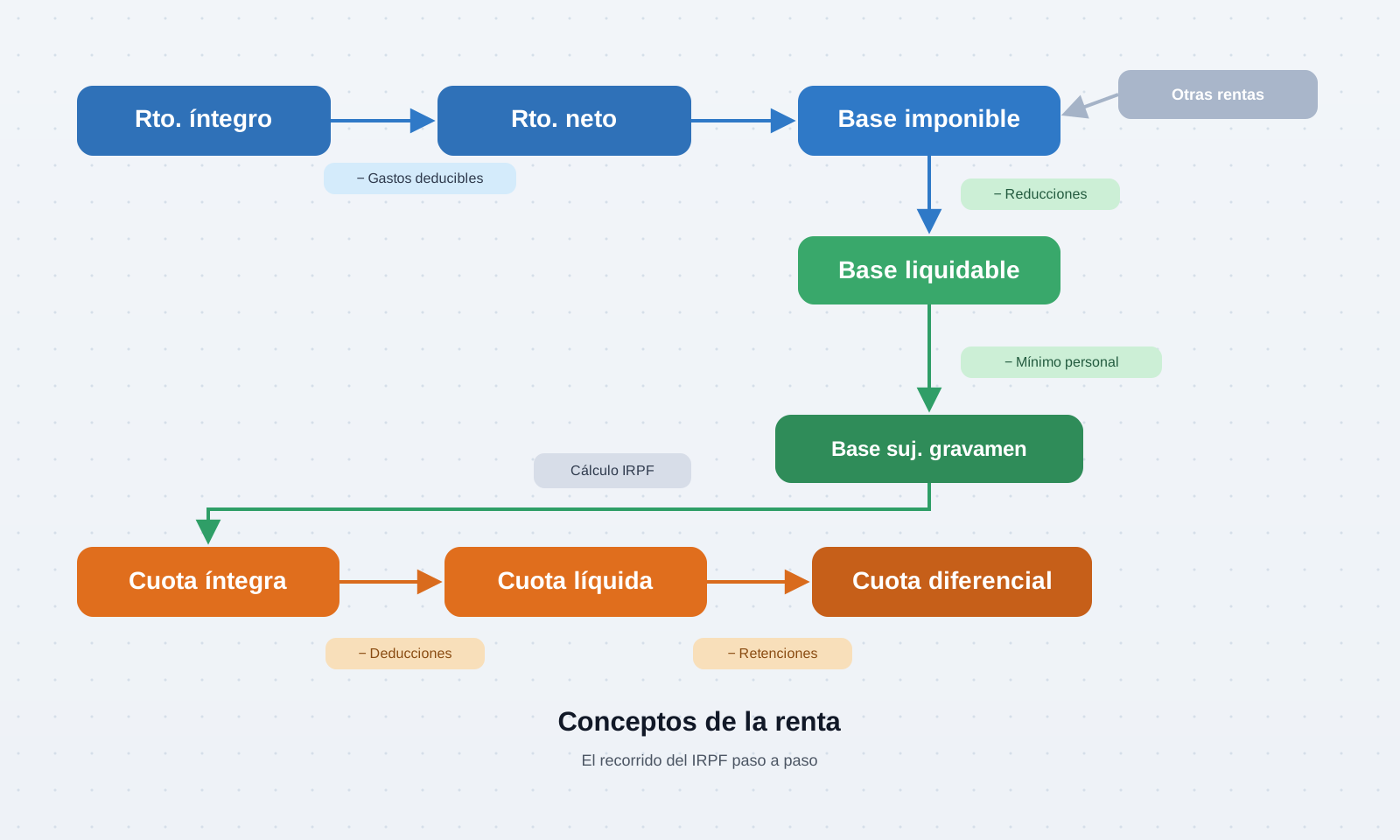
When you try to understand your Renta (annual income tax return), you come across a chain of terms that sound similar but mean different things. Rendimiento íntegro (gross income) or rendimiento neto (net income)? Base imponible (taxable base) or base liquidable (adjusted taxable base)? Cuota íntegra (gross tax liability), cuota líquida (net tax liability) or cuota diferencial (final tax balance)?
This article walks through the fundamental concepts of the IRPF (Impuesto sobre la Renta de las Personas Físicas — Spain's personal income tax) one by one, explained in plain language, ordered in the logical sequence in which they appear within the tax calculation, and clearly distinguished from each other so you never confuse them again.
Quick map of the main income tax concepts
Income tax is not calculated all at once. The IRPF works as a sequence of chained steps: each concept builds on the previous one until you reach the final result. Before diving into each definition, it helps to see the full journey.
The general structure follows this logic:
Rendimiento íntegro → Rendimiento neto → Rendimiento neto reducido → Base imponible → Base liquidable → Base liquidable sujeta a gravamen → Cuota íntegra → Cuota líquida → Cuota diferencial
Each step represents a specific phase of the calculation. The key point is that you cannot understand one without having seen the previous one.
From rendimiento íntegro to rendimiento neto reducido
Everything starts with a gross figure: the rendimiento íntegro. It is the initial amount, before any adjustments are applied. From there, certain deductible expenses are subtracted to arrive at the rendimiento neto, which is a more refined figure.
But the rendimiento neto is not the last stop before the base imponible. On top of the rendimiento neto, certain specific reductions may apply — such as the general reduction for employment income — to produce the rendimiento neto reducido (reduced net income). It is this reduced figure that ultimately feeds into the base imponible.
From the base imponible to the base liquidable sujeta a gravamen
Once the reduced net incomes have been calculated, the base imponible is built by grouping income according to its nature. Then, certain reductions are applied to that base and the result is the base liquidable.
But between the base liquidable and the cuota íntegra there is still one more step: the mínimo personal y familiar (personal and family allowance). By discounting its effect from the base liquidable, you get the base liquidable sujeta a gravamen (taxable base subject to taxation), which is the figure on which the tax is actually calculated.
From the cuota íntegra to the cuota diferencial
Once the base liquidable sujeta a gravamen has been established, you enter the tax liability phase. First, the cuota íntegra is calculated by applying the IRPF tax brackets. Then it is adjusted with deductions to arrive at the cuota líquida. And finally, by subtracting withholdings and payments on account, you reach the cuota diferencial.
Cuota íntegra, cuota líquida and cuota diferencial are three distinct phases within the same sequence. They are not synonyms.
What is the rendimiento íntegro in income tax
The rendimiento íntegro is the gross starting figure within the IRPF calculation. It is the total amount of income or earnings before subtracting any expenses, reductions or adjustments.
It is called "íntegro" (whole/complete) precisely because it captures everything received, with nothing yet deducted. It should not be confused with the rendimiento neto, nor with the amount that actually reaches your bank account, nor with the base imponible.
Key idea: the rendimiento íntegro is always the first number from which the calculation begins.
What the rendimiento íntegro includes
The rendimiento íntegro encompasses all earnings associated with a specific source of income. For example, in the case of employment income, it would include gross salary, bonus payments, supplements, benefits in kind and any other compensation linked to the employment relationship.
In general terms, any income that IRPF legislation considers computable within an income category forms part of the rendimiento íntegro. It is the starting amount before any refinement.
How it differs from other figures in the Renta
The rendimiento íntegro is not the same as the rendimiento neto, because you arrive at the neto after subtracting expenses. Nor does it equal the base imponible, which is a later figure that may group income from different sources. And it is not the base liquidable, which appears even further along the tax calculation chain.
Remember: the rendimiento íntegro is an early figure within the IRPF process, not a final result.
What is the rendimiento neto in income tax
The rendimiento neto is the figure that results from subtracting deductible expenses from the rendimiento íntegro. If the rendimiento íntegro is the gross starting point, the rendimiento neto is what remains once it has been refined.
It is always derived from the rendimiento íntegro: you take the gross figure and subtract the expenses that the legislation allows in each case (for example, Social Security contributions in the case of employment income). The exact nature of those expenses depends on the type of income, but the mechanism is always the same.
The rendimiento neto is the figure that, after applying specific reductions, will become part of the base imponible as the rendimiento neto reducido. Without it, the base imponible cannot be constructed.
Difference between rendimiento íntegro and rendimiento neto
The difference is straightforward: the rendimiento íntegro is the gross starting amount and the rendimiento neto is what remains after subtracting the applicable expenses.
In a nutshell: the íntegro is what comes in; the neto is what remains after refining it.
What is the rendimiento neto reducido
The rendimiento neto reducido is the figure that results from applying certain specific reductions to the rendimiento neto. It is an intermediate step between the rendimiento neto and the base imponible: while the neto is obtained by subtracting deductible expenses from the íntegro, the neto reducido arises from applying additional reductions on top of that neto.
It is this reduced figure that ultimately feeds into the base imponible. Without this phase, the net incomes would pass directly to the base, which could distort the calculation for certain taxpayers.
Remember: rendimiento íntegro → rendimiento neto (after expenses) → rendimiento neto reducido (after specific reductions) → base imponible.
What reductions are applied to obtain it
The reductions that transform the rendimiento neto into the rendimiento neto reducido depend on the income category. In the case of employment income, for example, the following reductions apply:
- The general reduction for employment income, which benefits taxpayers whose net employment income falls below certain thresholds.
- The reduction for irregular income, applicable to income generated over more than two years or considered notably irregular over time.
These reductions are not deductible expenses (those were already subtracted earlier), but rather additional adjustments that the legislation provides for certain types of income.
What is the base imponible in income tax
The base imponible is one of the major figures in the IRPF. It represents the amount from which the tax calculation begins to be built. It is not simply "everything you earn", but rather a base constructed according to the tax rules, grouping together various reduced net incomes and other types of income.
It works as an umbrella concept: within the base imponible, the different types of income you have received during the year are brought together, each one duly refined and, where applicable, reduced.
What it means for income to be included in the base imponible
"Integrating" income means including it within the corresponding tax base in the IRPF. Not all income goes to the same place: some goes to the base general (general base) and some to the base del ahorro (savings base). But the concept is the same: adding that income to the corresponding base so it forms part of the tax calculation.
When the legislation says that income "is included in the base imponible general", it simply means that it is added to that block.
What types of base imponible exist
There are two main blocks:
- Base imponible general (general taxable base): groups ordinary income such as employment income, real estate income and business income, among others.
- Base imponible del ahorro (savings taxable base): groups certain income linked to savings, such as investment income and certain capital gains and losses.
Not all income goes into the same compartment. This separation is essential to understanding the structure of the IRPF.
What is the base imponible general
The base imponible general is the IRPF block that groups ordinary income — that is, income that does not specifically belong to the savings category. It is called "general" because it is the main and broadest part of the base imponible, and the general IRPF tax brackets apply to it.
What income typically forms part of the base imponible general
The base imponible general concentrates ordinary income that does not belong to the savings category. The most common types include:
- Employment income (salaries, pensions...).
- Real estate income (rental income...).
- Business income (self-employment income...).
- Certain imputed income.
- Certain capital gains and losses not arising from a transfer.
What is the base imponible del ahorro
The base imponible del ahorro is the second major block of the base imponible. It gathers income linked to savings and certain capital gains arising from the transfer of assets.
What income typically forms part of the base imponible del ahorro
The most common categories included in the savings base are:
- Investment income (interest, dividends, life insurance proceeds...).
- Capital gains and losses from transfers (sale of shares, investment funds, real estate...).
This concept appears in the Renta whenever you have received bank interest, dividends or have sold shares or property.
Difference between base imponible general and base imponible del ahorro
The main difference is the type of income each one includes. The IRPF works like a tax with two parallel lanes: each block has its own base imponible, its own base liquidable and its own tax brackets.
| Base imponible general | Base imponible del ahorro |
|---|---|
| Employment income | Investment income |
| Real estate income | Capital gains and losses from transfers |
| Business income | |
| Imputed income | |
| Capital gains and losses without transfer |
What is the base liquidable in income tax
The base liquidable is the figure that results from applying certain reductions to the base imponible. You take the base imponible (general or savings) and subtract the applicable reductions — such as contributions to pension plans or the joint filing reduction — thereby obtaining the corresponding base liquidable.
It is important not to confuse reductions with deductions. Reductions act on the base; deductions act on the tax liability.
The term "liquidable" indicates that this base is now ready for the next steps of the calculation. The base imponible is what you have before reductions; the base liquidable is what remains afterwards. And it is from the base liquidable — once the mínimo personal y familiar has been discounted — that the tax is calculated.
What is the base liquidable general
The base liquidable general is the figure that results from applying the corresponding reductions to the base imponible general. They are not synonyms: the base liquidable general is the evolution of the base imponible general after applying the applicable reductions.
What reductions may affect it
Various reductions established by IRPF legislation may apply to the base imponible general. Among the best known are reductions for contributions to pension plans, the joint filing reduction and other reductions of a personal or family nature.
The effect is that the figure to which the tax brackets are applied is lower.
What is the base liquidable del ahorro
The base liquidable del ahorro is the equivalent of the base liquidable general, but within the savings block. It is obtained by applying the applicable reductions to the base imponible del ahorro. It works in parallel with the base liquidable general: while one covers the general part of the tax, the other covers the savings part.
Difference between base imponible and base liquidable
The base imponible is the earlier figure. The base liquidable is what results after applying the corresponding reductions. The reductions are the element that transforms one into the other.
The logical order is always:
- First, the base imponible is built (by adding up the reduced net incomes and other income).
- Then the reductions are applied.
- The result is the base liquidable.
In a nutshell: the base imponible is what you add up; the base liquidable is what remains after reducing it.
What is the base liquidable sujeta a gravamen
The base liquidable sujeta a gravamen is the figure that results from discounting the effect of the mínimo personal y familiar from the base liquidable. It is the amount to which the tax brackets are actually applied to calculate the cuota íntegra.
This concept does not always appear by name in standard explanations, but it is a real phase of the IRPF calculation. The base liquidable and the base liquidable sujeta a gravamen are not the same: the latter is always equal to or less than the former, because it already accounts for the mínimo personal y familiar.
How it is derived from the base liquidable
The logic is straightforward: you take the base liquidable and apply the effect of the mínimo personal y familiar. In practice, the IRPF calculation applies the tax brackets to both the base liquidable and the mínimo personal y familiar, and then subtracts the tax on the minimum from the tax on the base. The result is equivalent to taxing only the portion of the base that exceeds the minimum.
Put more simply: the base liquidable sujeta a gravamen is the portion of your base liquidable that actually generates tax, once the part protected by the mínimo personal y familiar has been discounted.
What is its relationship with the mínimo personal y familiar
The mínimo personal y familiar is precisely what separates the base liquidable from the base liquidable sujeta a gravamen. Without the minimum, both figures would be identical. The minimum acts as a shield that protects a portion of your base from effective taxation.
Remember: base liquidable − effect of the mínimo personal y familiar = base liquidable sujeta a gravamen. It is this last figure that translates into the cuota íntegra.
What is the mínimo personal y familiar
The mínimo personal y familiar (personal and family allowance) is the portion of income that the IRPF considers necessary to cover the basic needs of the taxpayer and their family. That portion of income is not subject to effective taxation: it acts as a protection threshold so that the tax takes into account the personal and family circumstances of each individual, such as the number of children, the taxpayer's age or the existence of dependent ascendants.
Technically, the tax brackets are applied to both the base liquidable and the minimum, and then the tax corresponding to the minimum is subtracted from the tax corresponding to the base. The practical effect is that the portion of income equivalent to the minimum is tax-free. In other words, the mínimo personal y familiar is the bridge between the base liquidable and the base liquidable sujeta a gravamen.
What is the cuota íntegra in income tax
The cuota íntegra (gross tax liability) is the first major tax figure that appears after applying the tax rates to the base liquidable sujeta a gravamen. The corresponding brackets and tax rates are applied (both on the general part and on the savings part) and the result is the cuota íntegra: the translation of the taxable base into a tax figure.
It is a phase that comes after the bases and before the deductions. It is still not the final figure: deductions and other adjustments come next.
What is the cuota líquida in income tax
The cuota líquida (net tax liability) is the figure that results from subtracting the applicable deductions from the cuota íntegra. It comes after the cuota íntegra and before the cuota diferencial.
While the cuota íntegra is the gross result of applying the tax brackets, the cuota líquida already incorporates the effect of any deductions the taxpayer may apply. These deductions can be state-level (established by the IRPF law) or regional (established by each autonomous community), such as the deduction for investment in a primary residence or others provided for in the legislation.
Difference between cuota íntegra and cuota líquida
The cuota íntegra is the tax figure before deductions. The cuota líquida is the tax figure after deductions. The difference between the two is precisely the amount of deductions applied.
What is the cuota diferencial in income tax
The cuota diferencial (final tax balance) is the final figure of the IRPF calculation. It is obtained by subtracting from the cuota líquida the withholdings, payments on account and, where applicable, other amounts already paid during the year. It is the last link in the chain and the one that determines the outcome of your Renta: how much you still owe or how much is owed back to you.
Difference between cuota íntegra, cuota líquida and cuota diferencial
The three cuotas represent successive phases within the IRPF calculation. None is a synonym of another:
| Concept | What it represents |
|---|---|
| Cuota íntegra | The result of applying the tax brackets to the base liquidable sujeta a gravamen |
| Cuota líquida | The result after subtracting deductions from the cuota íntegra |
| Cuota diferencial | The final result after deducting withholdings and payments on account |
The logical sequence is:
- Cuota íntegra → derived from the base liquidable sujeta a gravamen.
- Cuota líquida → derived by subtracting deductions from the cuota íntegra.
- Cuota diferencial → derived by subtracting withholdings and payments on account from the cuota líquida.
Remember: first íntegra, then líquida, finally diferencial. Each step subtracts something different.
Difference between reduction and deduction in income tax
Reduction and deduction are not synonyms, although they are often confused. The fundamental difference is at what point in the calculation each one acts, and therefore their practical effect is different. A 1,000 EUR reduction does not produce the same tax saving as a 1,000 EUR deduction.
What affects the base and what affects the tax liability
- Reduction: decreases the base imponible to convert it into the base liquidable. It acts before the tax liability is calculated.
- Deduction: decreases the cuota íntegra to convert it into the cuota líquida. It acts after the tax liability is calculated.
Key phrase: reductions lower the base; deductions lower the tax liability. Different moment, different effect.
Other frequently asked questions about income tax concepts
What does it mean to integrate income into the Renta
Integrating income means including it within the corresponding base imponible. When the tax authority says that income "is integrated into the general base", it simply means that the income is added to the general block to form part of the tax calculation. It is nothing more than a technical way of saying "add to the corresponding base".
What does it mean to offset income in the IRPF
Offsetting income means that certain losses can be subtracted from other gains or income within the tax. For example, if you have had capital losses, in certain cases you can offset them against gains of the same type. It is a mechanism that allows you to balance positive and negative results within the Renta.
It is not the same as integrating: integrating means adding income to the base; offsetting means subtracting a loss from a gain.
What is employment income in the Renta
Employment income (rendimientos del trabajo) is income received from an employment or similar relationship. It includes salaries, pensions, unemployment benefits and other earnings derived from personal work. It is the most common income category for the majority of taxpayers.
Within the IRPF calculation, employment income has its own rendimiento íntegro and its own rendimiento neto, and it is included in the base imponible general. If you want to see how this calculation works in practice, you can use our net salary calculator, which estimates IRPF withholding and net salary from gross salary.
What is investment income
Investment income (rendimientos del capital mobiliario) is income derived from assets that are not real estate: bank account interest, share dividends, life insurance returns, etc. It is typically included in the base imponible del ahorro.
What is real estate income
Real estate income (rendimientos del capital inmobiliario) is income derived from real estate, the most common being rental income from a home or commercial premises. It is included in the base imponible general, unlike investment income.
What are capital gains and losses
Capital gains and losses (ganancias y pérdidas patrimoniales) are changes in the value of assets that occur when transferring a good (selling shares, property, an investment fund...) or due to other circumstances. Depending on their origin, they are included in the general base or the savings base. This is a distinct concept from income, because it does not derive from a productive activity, but from a change in the value of an asset.
What does it mean for income to be exempt
Exempt income is income that, despite existing, is not subject to taxation under the IRPF. The law establishes a closed list of exempt income (such as certain public benefits, compensation or grants). Income being exempt means it is not included in the base imponible and therefore does not generate tax.
What is the difference between exempt and taxable income
Taxable income (rentas sujetas) is income that falls within the scope of the IRPF and forms part of the tax calculation. Exempt income (rentas exentas) also falls within the scope of the tax, but the law expressly exempts it from taxation. The practical difference is clear: taxable income is taxed and exempt income is not.
What does it mean for income to be taxed under the general base
It means that the income is included in the base imponible general and therefore the brackets and rates of the general part of the IRPF apply to it. This is the case for employment income, real estate income and business income, among others.
What does it mean for income to be taxed under the savings base
It means the opposite: the income is included in the base imponible del ahorro and the specific brackets and rates of that part apply to it. This is the case for bank interest, dividends and gains from the sale of shares or investment funds, for example.
Understanding which base each type of income is taxed under is essential to knowing how taxation works in Spain and what tax rate applies in each case.
Conclusion
The IRPF may seem complex, but in reality it works as a logical chain of concepts that build on one another. From the rendimiento íntegro to the rendimiento neto, and from there to the rendimiento neto reducido. From the base imponible to the base liquidable, and then to the base liquidable sujeta a gravamen. From the cuota íntegra to the cuota diferencial. Each step has a name and a specific function within the calculation.
Understanding these concepts does not mean mastering the legislation in detail, but rather having a clear mental map that helps you navigate your Renta. If you want to go deeper into how personal income tax works, you can consult our complete guide on what the IRPF is or learn about the current IRPF tax brackets in Spain. To prepare in advance, it is also useful to know how to download your tax data and review it before confirming the draft. And if you need a general overview of taxes in Spain, our taxation guide is a good starting point.
Sobre el contenido de esta guía
Este artículo ha sido escrito por Cristian Moreno para Finanzas Fáciles. Analizamos datos de organismos oficiales como el Banco de España y el INE.
Las guías se revisan periódicamente para reflejar cambios económicos y financieros en España. Este contenido es informativo y educativo. No constituye asesoramiento financiero, fiscal ni legal personalizado.