
Taxes
How to pay less in Renta 2025? State and regional tax deductions in Spain
Discover all the state and regional tax deductions available in Spain's Renta 2025 to reduce your income tax bill. We analyse each one — housing, family, energy efficiency and more — and explain how to apply them.
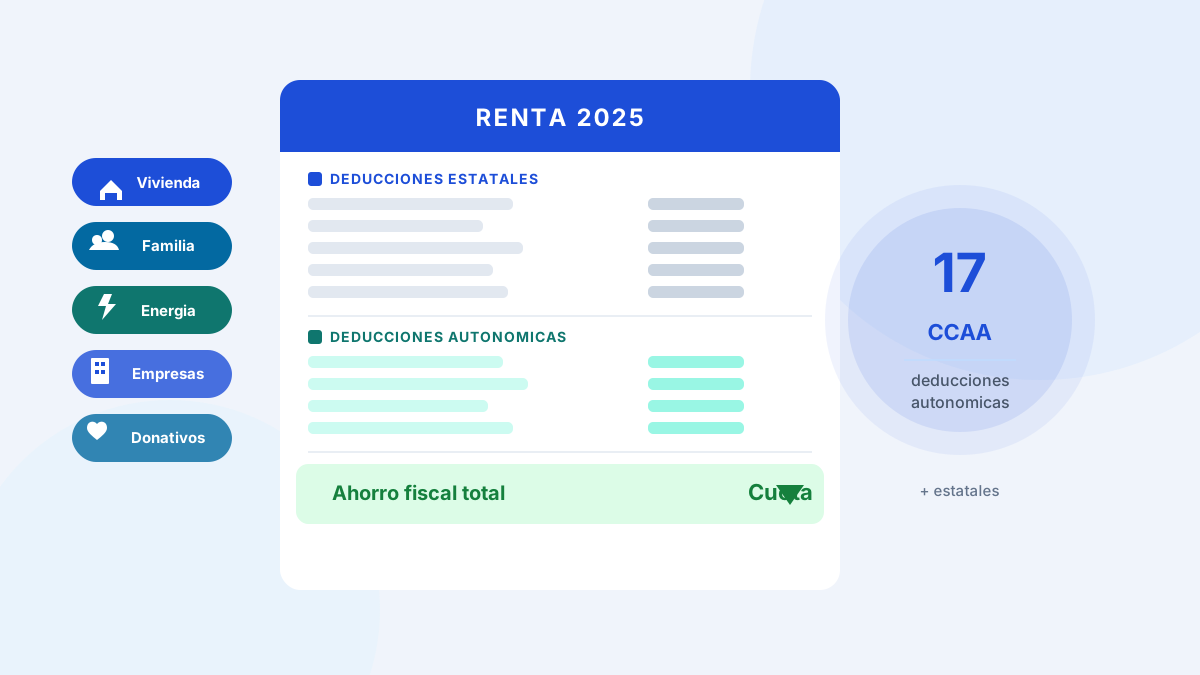
Spain's Renta 2025 tax return (the income tax campaign that opens in April 2026) is not just an administrative formality — it is also your annual opportunity to reduce your tax bill by applying every deduction the law allows. Those deductions fall into two broad categories: state-level deductions, which apply uniformly across mainland Spain, and regional deductions (deducciones autonómicas), which each autonomous community regulates independently and which can generate significant additional savings depending on where you live.
This guide covers both categories in full for tax year 2025. For each deduction you will find a plain-language explanation of who it is for, what it covers and a direct link to the official AEAT Practical Guide so you can check the technical details. If you want to understand the underlying tax framework first, the articles on what IRPF is and how it works and income tax concepts in Spain are a good starting point. For the full picture of Spanish personal finance tax content, visit the fiscalidad pillar.
How tax deductions work in Spain
Before diving into the list, a quick reminder of the mechanics. Spanish income tax is calculated by applying progressive rates to your taxable base, which produces the cuota íntegra (gross tax liability). Deductions are then subtracted directly from that liability — not from the taxable base — which makes them particularly powerful: every euro of deduction means one euro less in tax paid.
State deductions are governed by the national IRPF Law and apply equally to all contributors in the common territory (the Basque Country and Navarre have separate foral regimes). Regional deductions are approved by each autonomous community and apply only to the portion of the tax that corresponds to the regional rate. This means deductions at both levels can sometimes stack: the same circumstance — renting your home, for example — can give rise to both a transitional state deduction and a regional deduction at the same time.
State deductions in Renta 2025
The AEAT consolidates all state-level deductions in Chapter 16 of the Practical Guide to IRPF 2025. Here is a summary of each one.
Primary residence investment deduction: transitional regime
The general deduction for investment in a primary residence (vivienda habitual) was abolished in 2013, but it survives under a transitional regime for contributors who had acquired or commenced payments on their main home before 1 January 2013. If you meet that threshold, you can continue applying the deduction even though you have kept paying the mortgage after that date.
The official guide covers the transitional regime in detail, including the general conditions and the different modalities (acquisition, construction, extension, and renovation). If you have a mortgage that predates 2013, this remains one of the most valuable deductions to review every year.
Investment in newly or recently incorporated companies
This deduction is designed to encourage capital flows into startups and young companies. Business angels and early-stage investors who subscribe shares or holdings in a newly or recently created entity may benefit from it, provided both the investor and the company satisfy specific requirements.
The official guide sets out the deduction's scope, the maximum base, the applicable percentage, the requirements on the company, the conditions the contributor must meet, and the joint ceiling that applies alongside other deductions. It is particularly relevant for anyone active in Spain's start-up ecosystem.
Business investment incentives — direct assessment regime
This block applies to contributors who run economic activities under the direct assessment regime (estimación directa, normal or simplified). Through this route, the IRPF borrows the investment incentives from the Corporate Income Tax framework with appropriate adaptations.
The official guide distinguishes between the general regime and special regimes, investment in new tangible fixed assets or real estate investments tied to the business, the special regime for business investments in the Canary Islands, and the special fiscal regime of the Illes Balears. Self-employed contributors in direct assessment who have made significant capital investments should review this chapter carefully.
Business investment incentives — objective assessment regime
This block applies to contributors with economic activities taxed under the objective assessment regime (estimación objetiva, commonly known as módulos). The law states that investment incentives under this regime only apply when expressly established by regulation. For tax year 2025, the AEAT confirms that no such regulatory provision has been made, meaning this block generates no practical deductions for contributors in módulos this year.
Deductions for donations and other contributions
If you make charitable donations, this is one of the most important deduction blocks to review. It covers donations to entities governed by Law 49/2002 (foundations, declared public-utility associations, international development NGOs and similar bodies), donations to entities outside that special regime, and contributions to political parties, federations, coalitions and electoral groupings.
The deduction percentage varies by the nature of the recipient, and Law 49/2002 entities benefit from an additional incentive when the donor gives recurrently over multiple years. The official guide covers the common requirements and the maximum limit expressed as a proportion of the taxable base.
Deduction for income obtained in Ceuta or Melilla
Contributors who obtain certain types of income in the autonomous cities of Ceuta or Melilla are entitled to a specific state deduction, designed to compensate for their geographic remoteness and economic conditions. The official guide explains the different modalities depending on what type of income is involved, defines which income qualifies as obtained in those cities, and sets out the applicable maximum limit.
Deduction for habitual residence on the island of La Palma in 2025
This deduction applies to contributors whose habitual and effective residence is on the island of La Palma in the Canary Islands. The measure, introduced in the aftermath of the 2021 volcanic eruption and its lasting economic and social consequences, has been extended to cover tax year 2025. It follows the same logic as the Ceuta and Melilla deduction, adapted to the specific context of La Palma as an island territory that has suffered extraordinary damage.
Deduction for actions to protect and promote Spanish and World Heritage
This deduction covers certain investments or expenditure connected with Spanish Historical Heritage and UNESCO World Heritage. The qualifying scenarios listed in the official guide include the acquisition of certain goods forming part of the Spanish Historical Heritage, activities of conservation, repair, restoration, dissemination and exhibition of protected assets, and the rehabilitation, maintenance and improvement of protected buildings and their surroundings.
It has a narrower scope than housing or donation deductions, but is highly relevant for people involved in the management, conservation or acquisition of heritage-listed assets.
Rental of main residence deduction: transitional regime
The general state deduction for renting a main residence was abolished in 2015, but it remains in force under a transitional regime for contributors who were already entitled to it before that year and met the conditions then in effect. The official guide details who can still apply it in 2025, how it is calculated, the amount of the deduction, the deduction base and the maximum base.
This transitional state block coexists with regional rental deductions, which are entirely separate. If you have been renting under a contract predating 2015 and met the income and age requirements at the time, it is worth verifying whether you can still benefit.
Deductions for energy efficiency improvement works in homes
This state block covers three types of energy renovation works. The first applies to works that reduce the demand for heating and cooling in the home. The second covers works that reduce consumption of non-renewable primary energy. The third, with the broadest scope, addresses energy rehabilitation works in predominantly residential buildings.
Each line has its own deduction percentage, maximum base and documentary requirements — energy performance certificates play a central role in proving the improvement achieved. If you carried out qualifying works in 2025, you can find detailed guidance in the dedicated article on energy efficiency deductions in Renta 2025.
Deductions for the acquisition of electric vehicles and charging points
Two temporary state deductions coexist in this block: one for the purchase of certain new electric vehicles and one for the installation of charging infrastructure. Both apply a 15 % rate to the eligible base, with different ceilings — up to €20,000 for the vehicle and up to €4,000 for the charging point.
The official guide sets out the applicable percentage, maximum base, validity period and technical requirements for each. If you bought an electric car or installed a home charger in 2025, the article on the electric vehicle and charging point deduction in Renta 2025 covers every detail (currently available in Spanish).
Deduction for family units with members resident in the EU or EEA
This deduction is designed for family units in which one or more members have their tax residence in another EU Member State or in a country of the European Economic Area. The rationale is to ensure such families are not placed at a fiscal disadvantage because their members live in different countries.
The official guide defines the eligible cases, sets out the necessary conditions and explains how the deduction is calculated. It is a narrow deduction rather than a mass-market measure, but it is relevant for anyone in a cross-border family situation within the European space.
Regional deductions in Renta 2025 by autonomous community
On top of the state deductions, each contributor can apply those approved by their autonomous community of residence. The AEAT publishes a consolidated guide covering all of them at the Autonomous Community Deductions Guide for IRPF 2025. Below you will find a summary for each community with a link to its official section.
Andalucía
Andalucía offers deductions across five areas. On housing, it covers investment in protected primary residences and for young people, plus rental of the main residence. On family, it covers birth, adoption or fostering of minors, international adoption, single-parent families with elderly ascendants over 75, and large families. For disability and care, there are deductions for contributors with a disability, for a spouse or civil partner with a disability, for assistance to people with disabilities, and for domestic help. In education, health and personal spending, deductions cover educational expenses, physical activity and sport, veterinary expenses for pets or assistance dogs, and families with a diagnosed coeliac condition. Finally, in investment, work and donations, the region includes acquisition of shares in newly created companies, legal defence expenses in labour relations, and donations with an ecological purpose.
Aragón
Aragón structures its regional deductions around four blocks. On family, it covers birth or adoption of a third or subsequent child, birth or adoption of a child with a disability, international adoption, and birth or adoption of a first or second child in municipalities with fewer than 10,000 inhabitants. The dependency, elderly and nursery block includes care for dependent persons, a deduction for residents over 70, nursery costs for children under 3, and expenses for training towards independent living for minors with a disability. On housing and territory, key measures cover acquisition for victims of terrorism, acquisition or renovation in rural settlements and rental linked to mortgage-to-key handovers. In education, the region covers textbooks and school materials, and tutoring or extra classes. In investment and donations, it covers ecological and scientific donations, investment in MAB-listed shares, investment in new companies and investment in social economy entities.
Principado de Asturias
Asturias has one of the most extensive regional catalogues in Spain. On family and fostering, it covers non-remunerated fostering of people over 65, international adoption, multiple births, large families, single-parent families and fostering of minors. The descendants and young people block covers nursery costs for children aged 0–3, birth or adoption in depopulating municipalities, care for children or adoptees up to age 25, emancipation of young people up to 35, vital expenses of contributors up to 35, and deductions where a parent died in a workplace accident. On housing and rental, options include adaptation for people with disabilities, subsidised housing, standard rental, acquisition or renovation for specific groups, and landlord costs. The depopulation, work and education block covers self-employed workers in depopulating councils, public transport in those areas, training for scientific or technical roles, and relocation to Asturias. On environment, health and investment, notable deductions include sustainable forest certification, electric vehicle acquisition, ELA patient grants, investment in new companies, and coeliac disease expenses.
Illes Balears
The Balearic Islands offer deductions across six areas. On housing and rental, they cover sustainability improvement investments, standard rental, rental during temporary job-related relocation, landlord insurance premiums, other landlord costs, and compensation for illegally occupied housing or suspended evictions. On education, they cover textbooks, extracurricular foreign language learning, and higher education studies off the home island. The family and work-life balance block covers childcare for children under 6, birth and adoption. In disability, elderly and health, deductions apply to contributors with disabilities or with disabled dependants, expenses for people over 65 or with a disability, and ELA-related costs. On donations and patronage, the region has a broad catalogue covering research and innovation entities, cultural, scientific and technological patronage, sports patronage, Catalan language promotion and third-sector donations. On investment, employment and grants, there are deductions for investment in new companies, self-employment promotion, hard-to-fill vacancies and civil emergency relief grants.
Canarias
The Canary Islands have one of Spain's most comprehensive regional catalogues. On donations, heritage and formalities, it covers ecological donations, donations for the historical heritage of the Canaries, donations for cultural, sporting or scientific purposes, donations to non-profit entities, restoration of buildings of cultural interest, and the formal requirements and combined limits that apply. On education and mobility, the key deductions cover higher education costs, non-higher education costs, and relocation to another island for employment. The family, disability and care block includes birth or adoption, disability and elderly over 65, foster care, single-parent families, nursery expenses, large families, dependent relatives with a disability, and domestic employee social security contributions. On housing and rental, the Canaries cover primary residence investment, energy renovation works, disability adaptations, standard rental, mortgage-to-key rental, rental-purpose conversion of empty properties, landlord insurance and vacancy-to-market schemes. In other deductions, the region includes investment in new companies, a deduction for unemployed contributors and general illness expenses.
Cantabria
Cantabria has built a catalogue with a strong focus on combating rural depopulation. On housing and territory, it covers rental for young people, elderly and people with disabilities, improvement works, rental in at-risk municipalities, habitual residence in those municipalities, and renting out empty properties. On family and care, deductions cover caring for family members, fostering of minors, nursery expenses, single-parent families, birth or adoption, and domestic help. In education and health, it covers illness and education expenses. On mobility and depopulation, there are deductions for relocating to at-risk municipalities for work or study, and compensation for new residents. On investment and donations, the region covers donations to Cantabrian foundations, the Fondo Cantabria Coopera and disability associations, investment in new companies, investment in social economy entities, and new contributors coming from abroad.
Castilla-La Mancha
Castilla-La Mancha organises its deductions across five blocks. On family and care, it covers birth or adoption, large families, single-parent families, nursery costs, contributor disability, disability of ascendants or descendants, contributors over 75, care of elderly ascendants over 75, non-remunerated fostering of minors and non-remunerated hosting of elderly or disabled people. On housing, rental and territory, key measures include rental for under-36s, rental linked to mortgage-to-key operations, rental for large families or people with disabilities, interest on loans for a first home by under-40s, residence in rural areas, acquisition or renovation in rural areas and a savings-investment scheme for a first home. On education, it covers textbooks, language learning and other educational costs. On donations and investment, it covers donations for international development, R&D, cultural heritage and investment in new companies and social economy entities. On other, it covers veterinary expenses for assistance dogs.
Castilla y León
Castilla y León structures its deductions around five areas. On family and care, it covers large families, birth or adoption (including multiple births), adoption costs, care for minor children, domestic employee social security contributions and contributor disability. On housing and rental, options range from acquisition or renovation for young people in rural areas, through subsidised energy-efficiency renovations, rehabilitation of rural homes for rental, rental for young people, and purchase of newly built homes. On entrepreneurship and mobility, it promotes self-employment and sustainable transport. On heritage, donations and R&D, it covers investment in Castilla y León's historical, cultural and natural heritage, donations to regional foundations and funding for research, development and innovation. A technical section explains the order in which deductions are applied to the regional tax liability.
Cataluña
Catalonia organises its deductions into four main blocks. On family, it covers birth, adoption or fostering of a child, and a deduction for contributors who were widowed in 2023, 2024 or 2025. On housing, it covers rental of the main residence, renovation of the main residence, rental for victims of gender-based violence, and the regional tranche of the primary residence investment deduction. On studies, it covers interest on loans for master's and doctoral programmes — making Catalonia one of the few regions that incentivises postgraduate education financing specifically. On donations, it covers entities promoting Catalan or Occitan, scientific research and technological innovation entities, and entities protecting the environment, natural heritage and territory. On investment and others, it covers business angel investments in shares or holdings, the obligation to file a return when you have multiple payers, and investment in agricultural and housing cooperatives.
Extremadura
Extremadura organises its deductions around four blocks. On family and care, it covers employed workers, multiple births, fostering of minors, care for disabled relatives, care for children up to age 14, and a deduction for widowed contributors. On housing, rental and territory, it covers acquisition or renovation for young people and victims of terrorism, standard rental, landlords with empty properties, renovation in rural areas, residence in municipalities under 3,000 inhabitants, interest for young first-time buyers, and relocation to Extremadura. On education and donations, it covers school materials and donations to cultural, artistic and sporting entities. On investment and health, it covers investment in new companies, grants for ELA patients and a deduction for ELA patients and their families.
Galicia
Galicia has one of the most diverse regional catalogues in terms of subject areas. On family and care, it covers birth or adoption, families with two children, large families, fostering of minors, care of young children, and deductions for contributors with a disability aged 65 or over who need third-party assistance. On housing, rental and energy, it covers rental of the main residence, investment in renewable energy installations for self-consumption, renovation of properties in historic town centres, energy efficiency improvement works, acquisition and renovation in aldeas modelo rural regeneration schemes, adaptation of empty properties for rental, and rental of empty homes. On technology and investment, it covers home technology expenses for Galician households, investment in new companies (and financing for that investment), investment in MAB expansion-stage companies, investment in agricultural companies, and investment in companies of special public interest. On donations, grants and subsidies, it covers R&D donations, wildfire relief grants (PEIFOGA 2025), grants to elite Galician athletes, grants to ELA patients, and payments to people affected by thalidomide in Spain between 1950 and 1985. On education, it covers textbooks and school materials.
Comunidad de Madrid
Madrid stands out for a particularly comprehensive catalogue in the family and housing domains. On family and care, it covers birth or adoption, international adoption, fostering of minors, non-remunerated hosting of people over 65 or with a disability, care of ascendants, childcare for children under 3 or dependent elderly and people with disabilities, large family status (standard or special), and families with two or more dependants and reduced income. On housing, rental and territory, it covers rental of the main residence, landlord rental expenses, renting out empty properties, increased financing costs due to rising interest rates, relocation to depopulation-risk municipalities, purchase of a home there, interest on loans for house purchase by under-30s, and home purchase linked to birth or adoption. On education, it covers educational expenses and interest on loans for undergraduate, master's and doctoral programmes. On investment, employment and donations, it covers donations to foundations and sports clubs, investment in new companies, self-employment promotion for under-35s, investment in MAB-listed entities, and new contributors coming from abroad.
Región de Murcia
The Region of Murcia offers a broad regional catalogue structured around six blocks. On housing and rental, it covers investment in a primary residence by young people aged 40 or under, rental of the main residence, acquisition of a new primary residence or extension of the existing one for large families, and the transitional regime for the primary residence investment deduction. On family and work-life balance, deductions cover nursery costs, birth or adoption, work-life conciliation, working women, non-remunerated hosting of people over 65 or with a disability, and single-parent families.
On disability, health and wellbeing, the region covers contributors with a recognised disability, prescription glasses, contact lenses and cleaning solutions, sport and healthy-activity expenses, expenses linked to rare diseases, and veterinary costs. On education and connectivity, deductions apply to school materials and textbooks, language learning expenses and internet access costs. On savings, energy and mobility, the catalogue includes investments in water-saving household devices, installations for renewable energy self-consumption, electric vehicle purchases and the installation of electric vehicle charging infrastructure. On donations and investment, Murcia covers donations for the protection of the regional cultural heritage or for cultural, artistic, social, scientific-technological and environmental activities; donations for biomedical research; donations of goods listed in the Inventory of the Cultural Heritage of the Region of Murcia; and investment in shares or holdings in newly or recently created companies, in MAB-listed entities, and in social economy entities.
La Rioja
La Rioja organises its regional deductions around five blocks. On family and care, it covers birth and adoption of children, minors under emergency, temporary or permanent foster care arrangements or pre-adoption custody, nursery and childcare costs for children aged 0–3 in small municipalities, a deduction for each child aged 0–3 of contributors who move to or maintain residence in a small municipality for at least three years, and a deduction for children aged 0–3 attending nurseries or early childhood centres in any municipality.
The primary residence and rural block is especially broad: it covers acquisition, construction or renovation of a primary residence in small municipalities, investment in a primary residence by young people under 36, rental of the main residence for under-36s, renovation works on the primary residence, purchase or construction of a primary residence for young people, acquisition or renovation of a second home in a rural setting, adaptations to the primary residence for people with a disability, and measures to mitigate mortgage interest rate rises. On emancipation, territory and utilities, the region covers promotion of employed population settlement in rural areas, internet access for emancipated young people, and domestic electricity and gas supply for that same group.
On mobility, sport and health, La Rioja deducts the purchase of new electric vehicles, the purchase of non-motorised bicycles, physical exercise and sport, a deduction for ALS patients, and diagnosed coeliac disease. On donations, heritage and other, it covers irrevocable charitable donations under patronage rules, amounts directed to the investigation, conservation, restoration, rehabilitation or consolidation of La Rioja's historical heritage, and fees paid to professional agricultural organisations. The official guide also includes two territorial annexes listing the municipalities that qualify for the various territorial deductions and for the rural second-home deduction.
Comunitat Valenciana
The Valencian Community has one of the most extensive regional catalogues in all of Spain, structured around six blocks. On family and work-life balance, it covers birth, adoption, delegated custody for adoption or fostering; multiple birth or adoption; birth, adoption, fostering or delegated custody of a person with a disability; large families and single-parent families; nursery and first-cycle early education costs for children under 3; work-life conciliation; contributors with a disability of 33 % or more aged 65 or over; ascendants over 75 or over 65 with a disability; indefinite-contract employment of domestic employees for caregiving; and contributors with two or more descendants.
On housing, rental and territory, it covers landlords whose rental income does not exceed the private rental reference price; first-time purchase of a primary residence by people aged 35 or under; purchase of a primary residence by people with a disability; acquisition or renovation of a primary residence financed through public grants; rental or use-right payments for the main home; rental of accommodation for work in a different municipality; increased mortgage financing costs; conservation or improvement works on the primary residence carried out in the period; equivalent works carried out in 2014 and 2015; and habitual residence in a depopulation-risk municipality.
On energy, mobility and culture, the region covers investment in self-consumption or renewable energy generation installations, purchase of new vehicles covered under regional efficiency regulations, and cultural season pass purchases. On donations, heritage, language and formalities, it covers ecological donations, donations of goods forming part of the Valencian Cultural Heritage, donations for their conservation and restoration, amounts dedicated by owners to that conservation, donations for the promotion of Valencian language, and donations or loans for non-professional cultural, scientific or sporting purposes, along with the associated documentary requirements. On education, health and wellbeing, the Valencian Community covers school material purchases, fertility treatments at authorised clinics, certain healthcare expenses, and sport and healthy-activity costs. The public grants and extraordinary measures block includes COVID-19 related grants and donations and, notably, measures specifically directed at people affected by the DANA flooding of October 2024.
Frequently asked questions about tax deductions in Renta 2025
What is the difference between state and regional tax deductions in Spain?
State deductions are set by the national IRPF Law and apply equally across mainland Spain regardless of where you live — the pre-2013 mortgage deduction, the electric vehicle deduction and the energy renovation deductions are all examples. Regional deductions (deducciones autonómicas), by contrast, are approved by each autonomous community and only benefit contributors who are tax-resident in that territory. Both types are subtracted directly from the cuota íntegra (gross tax liability), not from the taxable base, and they are fully compatible with each other as long as each set of requirements is met independently.
How do I know which tax deductions I am entitled to in Spain?
Start from your personal and family situation: do you have children, are you a homeowner or renter, have you made charitable donations, purchased an electric vehicle, carried out energy renovation works, or care for a disabled or dependent family member? With that profile clear, review the state deductions in Chapter 16 of the AEAT's Practical Guide to IRPF 2025, then consult the regional deductions guide for your autonomous community. The draft tax return (borrador) may automatically include some figures, but regional deductions in particular are not always pre-populated, so a manual check is always advisable.
Where are regional deductions entered in the Spanish tax return?
Regional deductions have their own dedicated sections in the tax return, separate from the state-level ones. In Renta Web, look for the Deducciones autonómicas (regional deductions) section, where the application shows the deductions available for your community of residence. If a deduction does not appear automatically — common with deductions that require additional supporting documents such as school expenses or nursery receipts — you will need to enter it manually in the appropriate field. The AEAT's regional deductions guide indicates the exact box number for each deduction in each community.
What expenses are tax-deductible in Renta 2025?
Several large categories of expenditure attract deductions in the 2025 campaign. At state level, the main deductible items include mortgage payments on pre-2013 loans, energy renovation works in the home, electric vehicle or charging-point purchases, donations to foundations and NGOs, and investment in startups. At regional level, the most commonly deductible expenses include main-residence rental, school and nursery costs, specific healthcare expenses, donations to regional heritage, sustainable vehicle purchases and certain housing improvement works. In all cases, keep invoices and supporting documents safe, as the AEAT can request them.
Which Spanish autonomous community has the most tax deductions?
There is no single answer, because the "best" community depends on the profile of each taxpayer. A family with young children may find the most value in communities with generous nursery and birth deductions. A young renter will benefit more in regions with broad main-residence rental deductions. Someone who has made energy renovations or bought an electric vehicle needs to compare the regional add-ons to the state deductions. In terms of catalogue breadth, communities such as Asturias, the Valencian Community, the Canary Islands and Madrid have particularly long lists, but what matters is not the number of deductions available — it is how many apply to your specific circumstances.
Conclusion
Tax deductions in the Spanish IRPF are a genuine and accessible lever for reducing your fiscal bill. They require no special application process beyond correctly declaring them in your return, but they do demand knowing which ones apply to you and keeping adequate documentation.
State deductions apply across Spain and range from the classical pre-2013 mortgage to the newer electric vehicle, energy renovation, and start-up investment deductions. Regional deductions add a further layer that depends directly on where you live: in some autonomous communities the catalogue is very extensive and can translate into meaningful savings on housing, education, family expenses or donations.
To avoid leaving money on the table, the approach is straightforward: first review which state deductions match your situation, then consult the AEAT guide for your autonomous community to identify the regional deductions available to you.
To understand how deductions fit into the full tax calculation, read the article on income tax concepts in Spain. For a broader introduction to the Spanish tax system, visit the guide on taxation in Spain.
Sobre el contenido de esta guía
Este artículo ha sido escrito por Cristian Moreno para Finanzas Fáciles. Analizamos datos de organismos oficiales como el Banco de España y el INE.
Las guías se revisan periódicamente para reflejar cambios económicos y financieros en España. Este contenido es informativo y educativo. No constituye asesoramiento financiero, fiscal ni legal personalizado.