
Savings
Spain CPI and Euribor in September 2026: what to check if you have a mortgage, rent or savings
Spain's August 2026 flash CPI is 4.3% and Euribor is close to 3%. Learn what to review in your variable mortgage, rent, savings and household budget.
Spain CPI and Euribor in September 2026: what to check if you have a mortgage, rent or savings
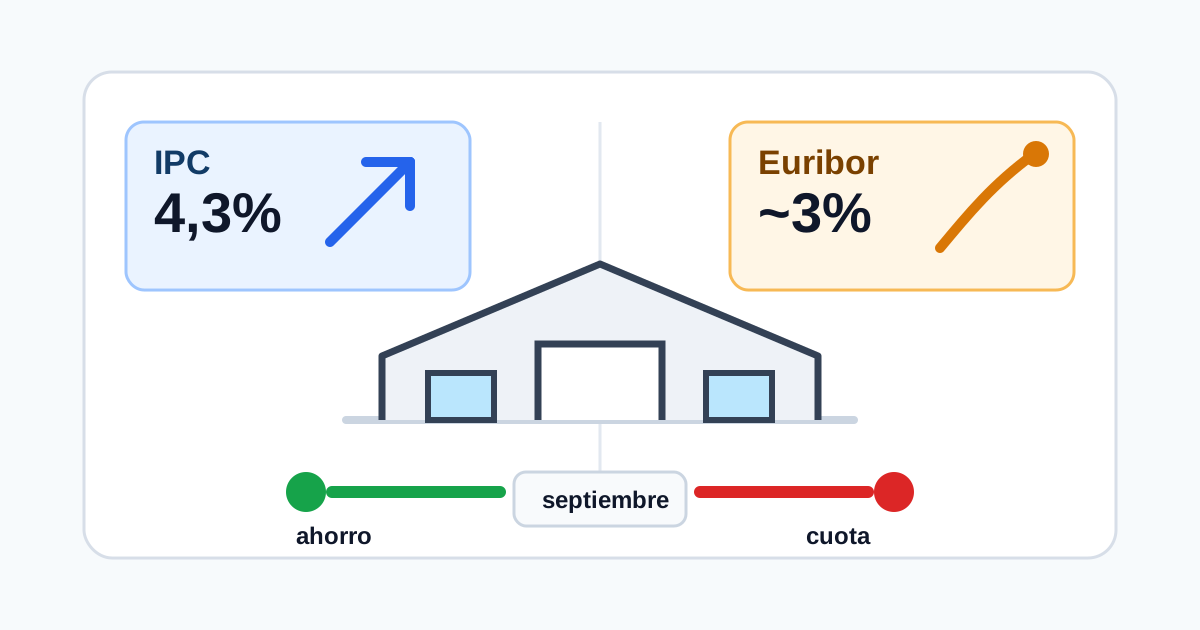
September 2026 starts with two figures that matter for household finances in Spain: the flash CPI estimate for August is 4.3%, according to Spain's INE, and Euribor is moving close to 3% in daily market data and August estimates. These are not abstract macro numbers. Inflation affects purchasing power, while Euribor affects the cost of many variable mortgages.
The practical point is not that every bill changes overnight. Each contract has its own rules. A mortgage resets on the date and index stated in the deed, rent can only be updated if the contract and legal framework allow it, and a savings account or deposit should be compared with real inflation, not only with other bank offers.
This article explains what to review now if you live in Spain and want to organise your September budget. For broader context, start with the savings pillar, the personal savings guide for Spain, and the explanation of what Euribor is and why it moves.
What happened with Spain's August 2026 CPI
INE published the flash CPI indicator for August 2026 on 28 August. The estimated annual inflation rate is 4.3%, seven tenths above July's 3.6%. The flash core inflation rate falls one tenth to 2.9%, while the harmonised index estimate stands at 4.5%.
This is still an advance estimate. INE's calendar schedules the final August CPI release for 15 September 2026. Even so, the flash figure is already useful as a warning signal: prices are putting renewed pressure on households at a time of year when many families face back-to-routine costs, utilities, school expenses, transport and annual budget adjustments.
Inflation matters because it does not behave like one single bill. It appears in repeated small purchases, savings goals that become too low, and the real return of conservative products. If your cash earns 2% while prices rise around 4%, your balance may increase nominally and still lose purchasing power.
What is happening with Euribor
The latest monthly official 12-month Euribor figure published in Spain's Official State Gazette is July 2026: 2.855%. That figure was already above previous months and is the official reference for mortgages that reset with July, depending on the contract terms.
For August 2026, several daily trackers show Euribor near 3%, with some daily readings around that level. The important distinction is this: until Banco de España and the BOE publish the official monthly August value, it is better to describe it as daily data or estimates, not as a closed official reference.
That does not make the move irrelevant. If your variable mortgage is due for review soon, a higher monthly average can translate into a higher payment. The exact result depends on outstanding principal, remaining term, bank spread, reset date and review frequency.
Why CPI and Euribor are connected
CPI and Euribor are not the same thing, but they are connected. CPI measures price changes. Euribor reflects the rate at which European banks lend to each other and is strongly influenced by expectations around interest rates, inflation and European Central Bank decisions.
When inflation remains high, markets may expect interest rates to stay higher for longer. That can push Euribor upward or make falls less likely. In turn, higher Euribor makes new mortgages and variable mortgage resets more expensive, reducing monthly room in indebted households.
The household takeaway is simple: if prices rise and financing costs rise, your monthly budget is pressured from two sides. That is why September is a good time to review cash flow rather than only read the headlines.
If you have a variable mortgage
First, avoid the wrong comparison. Looking at "today's Euribor" is not enough. Your bank will apply what your mortgage deed says: index, reference month, spread and reset date.
Check these five details:
- Exact reset date.
- Euribor reference month used by your contract.
- Spread over Euribor.
- Outstanding principal.
- Remaining term.
As an indicative example, if a mortgage moves from a reference rate close to 2.1% to one near 2.9%, the total rate rises by roughly 0.8 percentage points before considering any other contract detail. On a mortgage with a large outstanding balance, that movement can be visible in the monthly payment. On an older mortgage with little principal left, the impact is usually smaller.
For more mortgage-specific context, read the May 2026 Euribor variable mortgage article, the mortgage guide for Spain, and the guide on whether to pay off your mortgage early when Euribor rises.
If you rent your home
A 4.3% CPI figure does not mean every rent automatically rises by 4.3%. For an annual rent update to happen, it must be allowed under the contract and it must follow the applicable legal framework.
Since 2025, Spain has used a specific index for annual rent updates in certain housing rental contracts. INE publishes the Housing Rent Update Reference Index (IRAV), created to limit annual rent updates when that framework applies.
The practical review is:
- Check whether your contract allows annual updates.
- See which index the contract mentions.
- Verify whether the new rent update reference index applies.
- Check notice requirements and timing.
- Do not confuse an annual update with signing a new contract.
If you are already reviewing rent stability or public support, the guides on rental extensions in Spain in 2026 and Spain's Young Rent Bonus 2026 may help.
If you have savings in an account or deposit
With flash inflation at 4.3%, the question is not only how much interest your bank pays. The real question is how much purchasing power you are preserving.
An account paying 2% can be useful if it keeps your emergency fund liquid. A 3% deposit can make sense for money you do not need in the short term. But neither fully cancels the loss of purchasing power if inflation remains above that return.
Separate your money into layers:
- Monthly spending money: maximum liquidity.
- Emergency fund: liquidity and low risk.
- Goals over 6-18 months: remunerated account or short deposit, depending on terms.
- Long-term savings: a different strategy, with more time horizon and possibly investment.
The guide comparing a remunerated account and a time deposit in Spain can help with liquidity, AER, penalties and deposit protection. To organise the foundation, also review the emergency fund guide for Spain.
If your September budget is tight
The combination of high CPI and more demanding Euribor makes it useful to review your budget without panic. The goal is to identify what is structural and what is temporary.
Do a simple review:
- Calculate September net income.
- List fixed expenses: rent or mortgage, utilities, insurance, transport and basic food.
- Add one-off costs: school, travel, repairs, annual payments.
- Protect a minimum savings amount.
- Decide which variable expenses pause for 30 days.
If your mortgage payment may rise soon, simulate the new scenario before the direct debit arrives. If your rent may be updated, ask for the calculation and index used. If your savings are losing purchasing power, do not move everything at once: first confirm your emergency cushion and time horizon.
For a broader method, see the personal savings guide for Spain, the personal budget guide, and the emergency fund guide.
What not to do
There are three common mistakes when high inflation and rising Euribor appear together.
The first is deciding from a headline. A flash CPI estimate does not change all your contracts. A daily Euribor figure does not change your mortgage payment until your reset date arrives and the agreed reference is applied.
The second is using all your savings to repay a mortgage without keeping an emergency fund. Reducing debt can be a strong decision, but losing liquidity in a high-price environment can leave you exposed to any unexpected expense.
The third is chasing yield without reading conditions. A long deposit or promotional savings account can fit, but only if you understand the remunerated balance limit, term, fees, tax treatment and availability.
Frequently asked questions
Is Spain's August 2026 CPI final?
No. The 4.3% figure is the flash indicator published by INE on 28 August 2026. The official calendar schedules the final August release for 15 September 2026.
Is August 2026 Euribor official already?
The latest monthly official figure checked in the BOE is July 2026, with 12-month Euribor at 2.855%. For August there are daily data and estimates close to 3%, but it is better to wait for the official monthly publication before treating it as a closed reference.
Can my landlord raise rent by 4.3% because of CPI?
Not automatically. It depends on your contract, whether there is an update clause, which index applies and the current legal limits. For habitual housing, CPI should not be read as a universal automatic rent increase.
Should I repay my mortgage early if Euribor rises?
It can make sense if you have enough liquidity, no more expensive debt and fees do not reduce the benefit too much. Before repaying, compare reducing the monthly payment with reducing the term, and keep a reasonable emergency fund.
Conclusion
CPI and Euribor are different signals, but together they say something practical: September 2026 is a good time to review your budget, contracts and savings. The CPI flash estimate shows pressure on prices; Euribor near 3% points to more tension for variable mortgages if monthly references confirm the move.
The sensible response is not blind reaction. It is checking dates, contracts, indices and liquidity. If you know when your mortgage resets, how your rent can be updated and how much your savings really earn after inflation, you can adjust your plan before the month forces it on you.
Sobre el contenido de esta guía
Este artículo ha sido escrito por Cristian Moreno para Finanzas Fáciles. Analizamos datos de organismos oficiales como el Banco de España y el INE.
Las guías se revisan periódicamente para reflejar cambios económicos y financieros en España. Este contenido es informativo y educativo. No constituye asesoramiento financiero, fiscal ni legal personalizado.
Fuentes
- https://www.ine.es/dyngs/Prensa/adIPC0826.htm
- https://www.ine.es/dynt3/Calendario/calenHTML.htm
- https://www.boe.es/diario_boe/txt.php?id=BOE-A-2026-16997
- https://clientebancario.bde.es/pcb/es/menu-horizontal/productosservici/financiacion/hipotecas/
- https://www.ine.es/dyngs/INEbase/operacion.htm?c=Estadistica_C&cid=1254736177110&idp=1254735976607&menu=resultados
- https://www.boe.es/diario_boe/txt.php?id=BOE-A-2024-26685